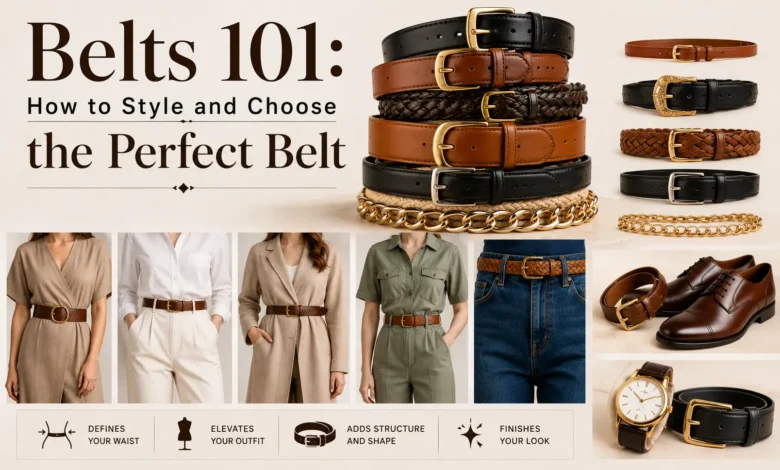
Belts are often treated as a purely functional accessory — something to keep your pants up and nothing more. But a well-chosen belt is one of the most effective tools for reshaping and elevating an outfit. It can define your waist, add structure to an oversized layer, break up a monochrome look, or simply finish off a pair of tailored trousers with a polished detail.
This guide covers how to choose the right belts for your wardrobe, how to style them across different outfits, and where belts fit into the bigger picture from our main Accessories Guide.
Types of Belts and Their Uses
Classic leather belts are the foundation of any belt collection — a simple strip of leather with a metal buckle, typically in black or brown. These are the most versatile option, working with jeans, trousers, and even some dresses.
Skinny belts are thin, often under an inch wide, and are designed more for style than function. They’re ideal for cinching dresses, adding definition over cardigans, or wearing with high-waisted trousers where you want a subtle detail rather than a bold statement.
Wide belts make a much stronger visual statement, often becoming the focal point of an outfit. They work especially well over dresses, tunics, or oversized shirts, where the width helps define the waist against loose fabric.
Statement and embellished belts feature bold buckles, studs, chains, or unique textures. These belts are meant to be noticed and work best when the rest of the outfit stays relatively simple, following the same focal-point principle covered in our main accessories guide.
Chain belts have moved from a purely trend-driven piece to a wardrobe staple, offering a lightweight, often adjustable alternative to leather that pairs particularly well with denim and slip dresses.
Woven and braided belts bring texture rather than shine, often made from leather strips or fabric, and tend to feel more casual — a natural fit for warm-weather outfits and relaxed denim.
How to Choose the Right Belt Size and Fit
Belt sizing can be confusing because it doesn’t always match your clothing size. As a general guideline, most belts should be purchased two inches larger than your pant size, since belt sizes are typically measured to the middle hole, allowing room to size up or down slightly as needed.
When trying on a belt, make sure the middle hole sits at your natural waist or hip, depending on where you intend to wear it, rather than forcing you to use the very last hole, which limits adjustability over time and looks less polished. A good belt should have at least two to three hole options that feel comfortable, giving you flexibility as your fit needs change slightly season to season.
Styling Belts by Outfit Type
Over dresses: A belt at the natural waistline instantly adds shape to a shift dress, wrap dress, or oversized shirt dress. Thin belts create subtle definition, while wide belts create a more dramatic hourglass effect. This is one of the fastest ways to make a single dress look like multiple different outfits depending on the belt used.
With high-waisted trousers or jeans: A classic leather belt through the loops finishes the look and adds a polished detail, especially with tailored trousers for work. Choose a buckle finish (gold, silver, or matte) that complements your other hardware, like your watch or jewelry.
Over coats and cardigans: Wrapping a belt over an open coat or cardigan, rather than through loops, cinches in the waist and adds structure to otherwise shapeless outerwear. This works particularly well with oversized silhouettes, balancing volume with definition.
With jumpsuits: Many jumpsuits are cut loose through the middle, and a well-placed belt at the natural waist can dramatically improve the fit and silhouette, turning a shapeless piece into something much more flattering.
Also Read our main Accessories Guide for how belts fit into the broader rule of three when combined with bags and jewelry.
Matching Belts to the Rest of Your Accessories
A classic styling guideline suggests matching your belt to your shoes, particularly in leather color and finish — brown belt with brown shoes, black belt with black shoes. This isn’t a strict rule anymore, but it remains a reliable, polished default, especially for work and formal settings. For more casual or fashion-forward looks, intentional contrast (a black belt with cognac boots, for example) can look just as considered, as long as the rest of the outfit ties the palette together.
Buckle finish is worth coordinating with your other jewelry and hardware. If you’re wearing gold jewelry and a gold watch, a gold or brass belt buckle creates a cohesive look, while a silver buckle can feel slightly disconnected. This is a subtle detail, but it’s the kind of consistency that separates a styled outfit from a thrown-together one.
Belt Styles at a Glance
| Style | Width | Best For | Formality |
|---|---|---|---|
| Classic Leather | Medium (1–1.5″) | Jeans, trousers, everyday wear | Casual to work |
| Skinny Belt | Thin (under 1″) | Dresses, cardigans, subtle definition | Smart-casual to formal |
| Wide Belt | Wide (2″+) | Dresses, tunics, statement looks | Casual to evening |
| Chain Belt | Varies | Denim, slip dresses, trend pieces | Casual to evening |
| Woven/Braided | Medium | Warm-weather, relaxed denim | Casual |
Common Belt Styling Mistakes to Avoid
Wearing a belt that’s too large or too small. A belt with too few adjustable holes left, or one that requires the very last hole, looks unpolished and limits flexibility as your fit needs shift slightly.
Ignoring buckle coordination. A mismatched buckle finish against your other jewelry and hardware (like a silver buckle with all-gold jewelry) can look disconnected rather than intentional.
Using a belt only for function. Treating belts purely as a way to hold up pants misses their potential to define silhouettes over dresses, coats, and jumpsuits.
Choosing the wrong width for the outfit. A very wide belt over a delicate blouse can overwhelm the fabric, while a thin belt over a heavy coat may look lost. Match belt width to the weight of the garment.
Neglecting leather care. A cracked, dry leather belt undercuts an otherwise polished outfit. Occasional conditioning keeps leather belts looking new for years.
Belts for Different Body Types and Preferences
Belts are one of the accessories where personal comfort should lead. Some people love the definition a wide belt creates at the natural waist, while others prefer a slimmer belt worn lower on the hip for a more relaxed silhouette. Both are valid styling choices — there’s no single “correct” way to wear a belt, and experimenting with placement (natural waist versus hip) and width is the best way to discover what you’re drawn to.
If you’re new to wearing belts as a styling tool rather than a functional necessity, start with a medium-width leather belt in a neutral color at your natural waist over a simple dress or tucked-in top. This is the easiest way to see the immediate visual impact belts can have before experimenting with bolder widths or placements.
Also Read: Scarves and Wraps: The Ultimate Styling Guide
Caring for Your Belts
Leather belts benefit from occasional conditioning to prevent cracking, especially if worn frequently or exposed to dry climates. Store belts hung or loosely coiled rather than tightly folded, which can create permanent creases over time. Keep metal buckles clean and dry to prevent tarnishing, wiping them with a soft cloth after wear if they’ve been exposed to moisture or sweat. For woven or fabric belts, spot cleaning is usually safer than full washing, which can loosen stitching or distort the shape.
Buckle Styles and What They Signal
The buckle is often the most noticeable detail on a belt, and different styles carry different visual weight. A simple, polished rectangular or oval buckle in gold or silver reads as classic and professional, ideal for work and everyday wear. A logo or branded buckle signals a specific designer aesthetic and works best when the rest of the outfit stays understated, letting the buckle serve as the clear focal point. Statement buckles — oversized, jeweled, or uniquely shaped — belong in the same category as bold jewelry: striking on their own, but best worn without competing accessories elsewhere in the outfit.
Hardware finish also matters for longevity. Solid brass and stainless steel buckles hold up better over time than plated alternatives, which can show wear at contact points from repeated buckling and unbuckling.
Frequently Asked Questions
What size belt should I buy?
As a general rule, buy a belt two inches larger than your pant size, since belt sizing is measured to the middle hole to allow room for slight adjustments over time.
Should my belt match my shoes?
Matching your belt to your shoe color, particularly in leather finish, remains a classic and reliable styling choice, especially for work and formal settings. In more casual or fashion-forward outfits, intentional contrast can also work well.
Can a belt really change how an outfit looks?
Yes. A belt can redefine the waistline, add structure to oversized pieces, and turn a single dress or jumpsuit into multiple distinct outfits simply by changing the width, placement, or color of the belt used.
Where should I wear a belt — natural waist or hips?
Both are stylistically valid. A belt at the natural waist creates more defined shaping, while a belt worn lower on the hips offers a more relaxed, casual look. Personal comfort and the specific outfit should guide the choice.
How many belts do I need in my wardrobe?
Two to three versatile belts — a classic black or brown leather belt, one wider statement belt, and one thin or chain belt — cover most styling needs without requiring a large collection.
Also Read: Weekend & Travel Outfit Ideas for Effortless Style On the Go