A capsule wardrobe is one of the most practical solutions to a problem nearly everyone has faced: standing in front of a full closet and still feeling like you have nothing to wear. Instead of relying on a large, loosely connected collection of clothes, a capsule wardrobe focuses on a smaller number of carefully chosen, highly versatile pieces designed to work together — producing far more outfit combinations than the piece count alone would suggest.
This guide walks through exactly how to build a weekly capsule wardrobe from scratch, including how many pieces you actually need, how to choose them strategically, and how to combine them into enough outfit variations to comfortably cover an entire week without repetition or daily decision fatigue.
The approach outlined here isn’t about extreme minimalism or forcing yourself to own as little as possible. It’s a practical system for maximizing versatility from a manageable number of pieces — one that works whether your goal is simplifying a chaotic closet, saving money on future purchases, or simply spending less time each morning deciding what to wear.
What a Capsule Wardrobe Actually Is
A capsule wardrobe is a curated, limited collection of clothing built specifically so that most pieces can be mixed and matched with most other pieces. Rather than owning dozens of outfits assembled as fixed sets, a capsule wardrobe treats each individual piece as a flexible building block, capable of combining with several others to create distinct looks.
The concept isn’t about owning as little as possible for its own sake. It’s about intentional versatility — choosing pieces specifically because they multiply your outfit options, rather than because they’re interesting on their own but hard to pair with anything else. A well-built capsule of 15–20 pieces can often produce more genuinely wearable outfit combinations than a disorganized closet three or four times its size.
It’s also worth noting that a capsule wardrobe doesn’t need to be your entire closet. Many people build a capsule specifically for one wardrobe zone — like work, or everyday casual wear — while keeping separate categories, like special-occasion pieces, outside the capsule structure entirely.
This zone-specific approach tends to work especially well for people early in the process, since it allows the capsule concept to be tested and refined on a smaller, lower-stakes portion of the wardrobe before deciding whether to expand it further.
Why a Capsule Wardrobe Makes Getting Dressed Easier
The core advantage of a capsule wardrobe is a dramatic reduction in daily decision-making. When every piece in a smaller collection has already been chosen specifically because it pairs well with most of the others, getting dressed becomes a matter of quick selection rather than trial and error.
Reduced decision fatigue. Decision-making is a limited mental resource that depletes throughout the day. A capsule wardrobe removes one of the first, and often most repetitive, decisions of the day — freeing up mental energy for more important choices later.
Easier packing and travel. Because every piece in a capsule is designed to combine with several others, packing for a trip becomes far simpler — a handful of capsule pieces can produce a full week of outfits without needing to overpack “just in case.”
Lower spending over time. A capsule wardrobe naturally discourages impulse purchases that don’t fit the existing color palette or style, since new additions are evaluated specifically against how well they’ll combine with what’s already there.
A more cohesive personal style. Because pieces are chosen deliberately to work together, a capsule wardrobe tends to produce a more visually consistent, intentional-looking closet than one built from scattered, unrelated purchases.
Together, these advantages explain why capsule wardrobes have remained a popular, enduring approach rather than a passing trend — the core benefits (less decision fatigue, easier packing, more deliberate spending, stronger visual cohesion) apply regardless of personal style, budget, or where someone happens to live.
Also Read: How to Build a Wardrobe That Matches Your Daily Routine
Step 1: Choose a Color Palette First
The single most important decision in building a capsule wardrobe is choosing a coordinated color palette before selecting individual pieces. Color coordination is what allows a relatively small number of items to combine in so many different ways — mismatched colors are the most common reason a capsule wardrobe fails to deliver on its versatility promise.
A reliable approach is to choose:
- 2–3 neutral base colors (such as black, white, navy, beige, or gray) that will make up the majority of your pieces and pair easily with almost anything
- 1–2 accent colors that complement your neutrals and add personality without overwhelming the palette
- A consistent color temperature — generally sticking to either warm-toned or cool-toned versions of your chosen colors, since mixing temperature can make even coordinated colors look slightly off together
Once a palette is set, every future piece can be evaluated quickly against a simple question: does this fit within my established colors? This single filter eliminates a significant portion of mismatched or hard-to-pair purchases before they ever enter the wardrobe.
A helpful way to test a proposed palette before committing to it is to lay out a few existing pieces you already own in similar tones and see how naturally they combine. If pieces in your chosen palette already pair easily with things you love wearing, that’s a strong signal the palette will work well as the foundation for a full capsule.
Step 2: Select Your Core Categories
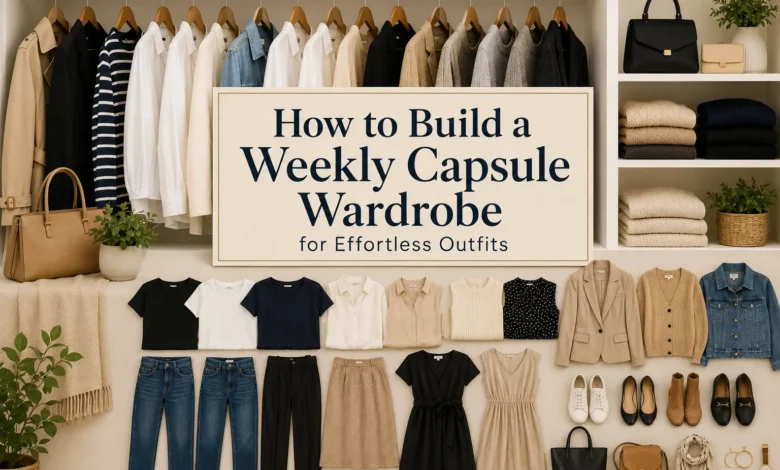
With a color palette established, the next step is filling out each core category needed to produce full outfits across a typical week. A functional capsule wardrobe generally includes:
Thinking category by category, rather than piece by piece, helps ensure balanced coverage — it’s easy to accidentally overload on tops while under-investing in layers or shoes, which limits the total number of complete outfits the capsule can actually produce, regardless of how many individual items it contains.
Tops. A mix of basic and slightly more detailed tops — simple t-shirts or blouses alongside one or two with more texture, pattern, or structure — gives enough variety without sacrificing coordination.
Bottoms. A smaller number of bottoms than tops is typical, since bottoms tend to be worn multiple times per week more easily than tops. Straight-leg trousers, well-fitting jeans, and one skirt or dress are common choices.
Layers. Cardigans, blazers, and light jackets extend the range of outfits significantly by allowing the same base pieces to look different depending on what’s layered over them.
Dresses (optional). For those who wear dresses regularly, one or two versatile dresses in the established color palette can function as a complete outfit on their own, while still pairing with capsule layers and accessories.
Shoes. A small rotation of shoes — one casual, one for work or slightly dressier occasions, and one comfortable everyday option — typically covers most weekly needs without excess.
Accessories. While not part of the core clothing count, a small rotation of accessories (a bag, jewelry, a scarf) plays an outsized role in refreshing repeated outfit combinations without adding new clothing at all.
A Sample 20-Piece Weekly Capsule
Here’s an example of how a 20-piece capsule might be structured for a fairly typical routine, built around a neutral base with one or two accent colors.
| Category | Pieces | Example Items |
|---|---|---|
| Tops | 7 | 3 basic tees, 2 blouses, 1 knit sweater, 1 patterned top |
| Bottoms | 4 | 2 pairs of jeans, 1 tailored trouser, 1 skirt |
| Layers | 3 | 1 blazer, 1 cardigan, 1 lightweight jacket |
| Dresses | 2 | 1 casual dress, 1 slightly dressier dress |
| Shoes | 4 | Sneakers, flats, ankle boots, one dressier pair |
With this structure, tops and bottoms alone can create numerous base outfits, and layering pieces, dresses, and shoe choices multiply those combinations significantly further — comfortably producing enough distinct outfits to avoid noticeable repetition across a two-week span.
Step 3: Calculate Your Outfit Combinations
One of the most motivating parts of building a capsule wardrobe is seeing just how many outfit combinations a relatively small collection can produce, once color coordination is in place.
As a simple example: 7 tops paired with 4 bottoms already produces 28 possible top-and-bottom combinations. Adding 3 layering pieces that can be worn with any of those combinations multiplies the total further, and varying shoes and accessories multiplies it again. Even without counting dresses separately, a well-coordinated 20-piece capsule can realistically produce well over 50 distinct, wearable outfit combinations.
This math is the real payoff of the color-first approach described earlier. A capsule built without coordinated colors might technically contain the same number of pieces, but far fewer of them will actually combine successfully — which is why two capsules of identical size can feel dramatically different in how versatile they actually are day to day.
It can also help to physically test this once your capsule is assembled. Laying out a handful of tops and bottoms together, then trying different layering and shoe combinations, quickly reveals which pairings genuinely work and which don’t — often uncovering even more usable combinations than expected, simply because it’s easy to underestimate versatility when pieces are only viewed individually rather than side by side.
How to Build Your Capsule Around Your Real Life
A capsule wardrobe works best when it’s built around your actual weekly routine rather than a generic template. Before finalizing your piece selections, consider:
Your dominant environment. If most of your week is spent in a work setting, your capsule should lean more heavily toward work-appropriate pieces, with fewer purely casual items. The reverse applies for a mostly casual or remote routine.
Your climate. A capsule built for a consistently warm climate will look very different from one built for a region with distinct seasons, which may require a slightly larger collection to account for layering needs across temperature changes.
Your comfort priorities. If your days involve a lot of movement, standing, or physical activity, prioritize fabrics and fits that support comfort alongside style, rather than choosing purely for appearance.
Your existing wardrobe. Before buying anything new, sort through your current closet and identify which pieces already fit the color palette and versatility criteria of a capsule. Many capsule wardrobes can be built largely, or entirely, from pieces already owned, with only a few strategic additions needed to fill genuine gaps.
Your personal style preferences. A capsule wardrobe should still feel like an authentic reflection of your taste, not a generic template. If bold colors or distinctive patterns are important to how you express your style, build them into your palette from the start rather than defaulting entirely to neutrals for the sake of easier coordination.
Also Read: Trend vs. Timeless: Finding Your Personal Style Balance
Common Capsule Wardrobe Mistakes
- Skipping the color palette step. Selecting pieces before establishing a coordinated palette is the most common reason a capsule wardrobe fails to deliver its promised versatility.
- Choosing pieces that are too similar. A capsule made up of nearly identical basics can feel monotonous. A mix of textures, subtle patterns, and slightly varied silhouettes within the same palette keeps outfits feeling distinct.
- Building a capsule around an idealized life rather than a real one. Prioritizing formal or occasion-specific pieces in a capsule meant for daily wear leads to a wardrobe that doesn’t actually match how the week unfolds.
- Ignoring fit in favor of matching colors. A perfectly coordinated capsule still needs each piece to fit well; ill-fitting clothing undermines the polished, intentional look a capsule wardrobe is meant to produce.
- Treating the capsule as permanently fixed. A capsule wardrobe should evolve with the seasons and with changes in routine, rather than staying frozen exactly as originally built.
- Overbuying before testing the concept. Committing to a full 20-piece purchase before testing the approach with a smaller trial capsule can lead to costly missteps if the color palette or category choices don’t end up working as well as expected in practice.
- Neglecting to account for laundry cycles. A capsule sized without considering how often you can realistically do laundry can leave you short on options mid-week. Building in enough duplicates of frequently worn basics, like everyday tops, helps avoid this gap.
Frequently Asked Questions
How many pieces should a weekly capsule wardrobe have?
Most weekly capsules work well with 15–20 clothing pieces, plus a small rotation of shoes and accessories. The exact number depends on your routine, climate, and how much variety you personally want week to week.
Do I need to buy all new clothes to build a capsule wardrobe?
No. Most people can build a significant portion of a capsule from pieces they already own, particularly if those pieces already share a similar color palette. New purchases should focus specifically on filling genuine gaps.
How do I choose the right color palette for my capsule?
Start with 2–3 neutral colors you already wear often and feel confident in, then add 1–2 accent colors that complement them. Keeping a consistent color temperature (warm or cool) across the palette makes coordination easier.
Can a capsule wardrobe work for a highly varied lifestyle?
Yes, though it may require building either a slightly larger capsule or a couple of smaller, zone-specific capsules — one for work, one for casual life — rather than trying to cover every context with a single, small collection.
How often should I update my capsule wardrobe?
A seasonal review is typical, adjusting for weather changes and any shifts in your routine. A full capsule doesn’t need to be rebuilt each season — usually just a handful of pieces need to be swapped or refreshed.
What’s the easiest way to start if a full capsule feels overwhelming?
Start with a smaller trial capsule — around 10 pieces in a simple color palette — and test how well the combinations work in practice before committing to a larger investment.
Will a capsule wardrobe feel repetitive over time?
Not if it’s built with enough variety in texture, layering options, and accessories. The combination math tends to surprise most people — a well-coordinated capsule typically produces far more distinct outfits than expected, especially once accessories are factored in to refresh repeated base combinations.
A weekly capsule wardrobe isn’t about owning less for its own sake — it’s about choosing pieces deliberately so that a smaller collection works far harder for you than a larger, uncoordinated one ever could. Start with a color palette, build out from your real routine, and the effortless outfits will follow naturally. Revisit the capsule each season, and it will continue to serve you long after the initial setup is done.
Also Read: Fashion Lifestyle: How Your Style Choices Shape Your Everyday Life