Most closet frustration doesn’t come from owning too few clothes — it comes from owning the wrong ones. A closet packed with pieces that don’t actually fit your day-to-day life will always feel disorganized, no matter how much you own or how often you shop. The real fix isn’t more clothes; it’s a wardrobe that’s been deliberately built around how you actually spend your time.
This guide walks through exactly how to audit your routine, identify the gaps in your closet, and build a wardrobe that works with your life instead of against it — so getting dressed stops being a daily source of stress and starts being fast, simple, and genuinely enjoyable.
This isn’t about owning fewer clothes for the sake of minimalism, or owning more clothes for the sake of variety. It’s about alignment — making sure the ratio of what’s in your closet actually mirrors the ratio of how you spend your time. A closet dominated by formalwear when you rarely dress formally, or one missing reliable work outfits when you’re in the office five days a week, will always feel mismatched no matter how stylish the individual pieces are.
Why Most Wardrobes Don’t Match Real Life
It’s easy to build a wardrobe based on who you want to be on your best day — the version of you that attends five events a month, works out every morning, and never repeats an outfit. But most people’s actual lives are far more repetitive: a handful of environments (work, home, errands, the occasional evening out) repeated in slightly different combinations, week after week.
The disconnect happens when shopping decisions get made based on inspiration rather than routine. A dress bought for an event that only happens once a year, or a blazer purchased because it looked appealing online, can sit unworn for months while your closet still somehow feels short on options for an ordinary Tuesday. The problem usually isn’t quantity — it’s that too much of what you own doesn’t map onto how your week actually unfolds.
Building a wardrobe around your real routine flips this. Instead of buying clothes and hoping they’ll fit into your life, you start with your life and work backward to the clothes that support it. The result is a closet where a much higher percentage of what you own actually gets worn, and getting dressed becomes far less of a daily decision-making exercise.
Consider two people with identical budgets and closet sizes. One shops based on inspiration — a pair of statement boots here, a trend-driven jacket there — and ends up with a visually interesting but disconnected collection of pieces that rarely combine into full outfits. The other shops based on a clear picture of their actual week, choosing pieces specifically because they complete outfits they already know they’ll wear. The second closet will almost always feel more functional, even if it’s smaller or less individually striking, simply because every piece has a defined role.
Also Read: How to Wear Color Without Overdoing It: The One-Punch Rule for Confident Dressing
Step 1: Audit Your Actual Weekly Routine
Before making any wardrobe changes, it helps to get a clear, honest picture of how your week actually looks — not how you imagine it, but how it really plays out.
Start by mapping out a typical week, day by day, and noting:
- Where you spend most of your time — an office, a hybrid setup, home, outdoors, client meetings, a physically active job
- What level of formality each environment expects — business formal, business casual, athleisure, no real dress code at all
- How often your environment changes — do you move between very different settings in a single day, or does one setting dominate most of the week?
- What activities require specific clothing — a commute by bike, standing for long shifts, frequent travel, workouts before or after work
- How much of your week is genuinely unpredictable — last-minute meetings, spontaneous plans, or a schedule that shifts week to week
Once this picture is clear, patterns tend to emerge quickly. Most people discover that 70–80% of their week falls into just two or three recurring “modes” — for example, a work mode, a casual weekend mode, and an occasional dressier mode for social plans. Everything else is a smaller, occasional category that doesn’t need to dominate the closet.
This audit is the single most important step in the entire process. Skipping it and going straight to shopping is exactly how mismatched wardrobes happen in the first place — because without a clear picture of your actual routine, it’s nearly impossible to judge whether a new piece will genuinely earn its place in your closet.
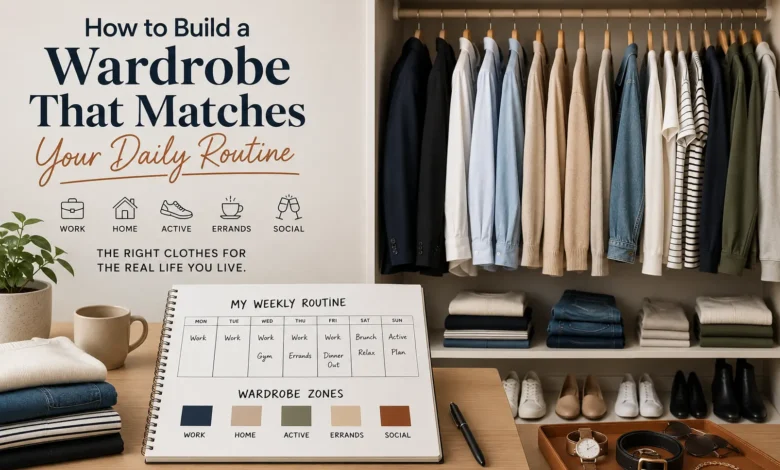
Step 2: Identify Your Wardrobe “Zones”
Once you understand your weekly patterns, the next step is translating them into distinct wardrobe “zones” — categories of clothing built specifically around each recurring part of your life. Most people’s routines fall into some combination of the following:
The work zone. Whatever your job requires, whether that’s tailored pieces for a client-facing role, smart-casual basics for a hybrid office, or durable, practical clothing for physically active work. This zone should reflect your workplace’s real expectations, not a generic idea of “professional.”
The everyday casual zone. The clothes worn for errands, casual weekends, and downtime at home. This zone benefits most from comfort and durability, since it likely gets the heaviest daily use of any category.
The active or fitness zone. For anyone with a regular workout routine, commute by bike, or physically active hobbies, this zone needs to perform well functionally while still feeling like an extension of your personal style rather than a completely separate wardrobe.
The social or evening zone. Pieces for dinners, dates, and social plans that fall outside your everyday routine. This zone can be intentionally smaller than the others, built around a few versatile, elevated pieces rather than a large rotation.
The occasional or formal zone. Clothing for rare events — weddings, formal work functions, major celebrations. Because this zone is used infrequently, it’s the one place where owning fewer, rental, or borrowed pieces often makes more practical sense than a full personal collection.
Mapping your closet against these zones — rather than against loose categories like “tops” and “bottoms” — makes it much easier to spot where you’re genuinely underprepared (a work zone with only two usable outfits) versus where you’re overinvested relative to how often that zone actually gets used (a large formal-event wardrobe for a life with very few formal events).
A useful exercise here is to physically separate your existing closet into these zones, even temporarily. Many people are surprised to discover just how lopsided their wardrobe actually is once it’s organized this way — often revealing a work zone stretched thin across only a couple of reliable outfits, alongside an oversized occasional zone full of pieces worn once or twice a year, if at all. Seeing the imbalance directly, rather than just sensing that “something feels off” about your closet, makes it much easier to prioritize future purchases correctly.
Step 3: Build Around Outfit Formulas, Not Individual Pieces
One of the most effective shifts in building a routine-matched wardrobe is thinking in terms of complete outfit formulas rather than individual clothing pieces. An outfit formula is a repeatable combination — for example, “fitted trousers + tucked-in top + blazer + loafers” — that can be recreated with slight variations using different pieces you own.
This approach matters because a wardrobe built purely from individual “nice pieces” often fails to actually produce full outfits. It’s common to end up with several tops that don’t pair well with any of your bottoms, or a great blazer with nothing underneath that suits it. Building around formulas instead ensures every new piece is chosen specifically because it completes or expands an outfit you already know works.
A practical way to apply this: identify two or three reliable outfit formulas for each of your wardrobe zones. For a work zone, that might be a trouser-and-top combination, a dress-and-cardigan combination, and a more casual jeans-and-blazer combination for less formal days. Once you have a small set of formulas that consistently work, shopping becomes far more targeted — you’re filling specific gaps in formulas you already rely on, rather than buying pieces that only theoretically “might work” with something.
This also makes travel and packing considerably easier. Once you know your reliable formulas, packing for a trip becomes a matter of selecting a few formulas that suit the destination and duplicating the pieces that make them work, rather than guessing at random combinations and overpacking “just in case.” The same logic applies to everyday mornings — when you already know which combinations work, getting dressed becomes a matter of selection rather than invention.
Also Read: How to Build a Capsule Wardrobe in 2026: The Step-by-Step Guide for Every Budget
A Sample Routine-Based Wardrobe Breakdown
The exact proportions of your wardrobe should reflect your own routine audit, but here’s a general framework showing how closet space might be allocated for a fairly typical hybrid-work routine.
| Wardrobe Zone | Approx. Share of Closet | Example Pieces |
|---|---|---|
| Work | 35–40% | Trousers, blouses, blazers, work-appropriate shoes |
| Everyday casual | 30–35% | Jeans, t-shirts, casual dresses, sneakers |
| Active/fitness | 10–15% | Leggings, athletic tops, supportive footwear |
| Social/evening | 10–15% | A few dresses or elevated separates, versatile shoes |
| Occasional/formal | 5% or less | One or two formal pieces, or a rental plan |
If your own routine looks different — say, a fully remote job with almost no in-person work dressing, or a highly active lifestyle with frequent outdoor activities — these proportions should shift accordingly. The goal isn’t to match a universal formula; it’s to make sure your closet’s actual space and spending roughly mirror how you actually spend your time.
How Many Pieces You Actually Need
A common misconception is that a well-functioning wardrobe requires a large number of items. In practice, a relatively small, well-chosen set of pieces — particularly when built around the outfit-formula approach above — can comfortably cover a full routine.
As a general guide:
- 10–15 versatile tops across your main zones is usually enough to avoid repetition within a two-week span
- 5–8 bottoms in coordinating colors can pair with nearly every top you own
- 3–5 layering pieces (blazers, cardigans, jackets) extend the range of outfits significantly without adding bulk
- 4–6 pairs of shoes covering work, casual, active, and one dressier option typically covers most routines
- A small, rotating set of accessories can refresh repeated outfits without adding new clothing at all
The exact numbers matter less than the underlying principle: a wardrobe built around a smaller number of genuinely versatile pieces, chosen specifically to match your real routine, will almost always outperform a much larger closet filled with items that don’t consistently work together.
Signs Your Wardrobe Doesn’t Match Your Routine
A few common indicators suggest it may be time to realign your closet with how you actually live:
- You regularly feel like you have “nothing to wear” despite a full closet
- You reach for the same 4–5 outfits repeatedly while dozens of other pieces sit untouched
- You own multiple pieces for events or activities that rarely, if ever, happen
- Getting dressed for work, errands, or casual outings consistently takes longer than it should
- You’ve bought several pieces recently that still haven’t been worn even once
- Your wardrobe feels visually inconsistent, with pieces that don’t pair well with anything else you own
If several of these sound familiar, it’s usually a sign that shopping has been happening ahead of — or disconnected from — an honest picture of your actual routine, rather than in response to it.
Maintaining a Routine-Matched Wardrobe
Building a wardrobe around your routine isn’t a one-time project. Life changes — a new job, a move, a shift in daily habits — and your closet needs to shift with it. A few habits make this easier to maintain over time:
Revisit your routine audit seasonally. A quick check-in every few months helps catch changes early, before your closet quietly drifts out of sync with your actual week.
Shop against specific gaps, not general boredom. Keep a short running list of pieces genuinely missing from your outfit formulas, and shop against that list rather than buying reactively.
Retire pieces that no longer fit a zone in your life. If a wardrobe zone shrinks — say, fewer formal events than in previous years — it’s worth letting go of some pieces from that category rather than holding onto them indefinitely.
Pay attention to what you actually reach for. The outfits you repeat most often are the clearest signal of what’s genuinely working. Use that pattern to guide future purchases, rather than starting from scratch each shopping trip.
Treated this way, your wardrobe becomes a living reflection of your actual life rather than a fixed collection — adjusting naturally as your routine evolves, instead of requiring a dramatic overhaul every time something changes.
Also Read: Capsule Wardrobe Essentials 2026: What to Keep, What to Buy, and What to Skip
Frequently Asked Questions
How do I start building a wardrobe around my routine if I already own a lot of clothes?
Begin with the audit step before touching your closet. Once you have a clear picture of your actual weekly routine, sort your existing clothes into the zones that match it — you’ll likely find you already own more of what you need than expected, along with some clear gaps.
What if my routine changes often or is unpredictable?
Focus on a few highly versatile pieces that work across multiple zones — for example, a blazer that works for both a client meeting and a dinner out. A flexible routine benefits even more from cross-functional pieces than a fixed one does.
Should I get rid of clothes that don’t fit any of my current zones?
In most cases, yes. Pieces that don’t match any part of your actual routine tend to sit unworn regardless of how much you like them. Donating, selling, or storing them elsewhere frees up space for what you’ll genuinely use.
How often should I reassess my wardrobe against my routine?
A seasonal check-in — roughly every three to four months — is usually enough to catch meaningful shifts without turning it into a constant project.
Is it better to buy new pieces for each zone or work with what I already own first?
Always start with what you already own. Reorganizing and restyling existing pieces around your zones often reveals workable outfits you’d overlooked, and clarifies which gaps are genuinely worth new spending.
Can this approach work with a small budget?
Yes — in fact, it often works better on a smaller budget, since shopping becomes far more targeted. Instead of broad, general purchases, you’re buying specific pieces to complete outfit formulas you already know you need.
A wardrobe that matches your daily routine isn’t built through a single big shopping trip — it’s built by understanding your real week, organizing your closet around it, and making future purchases with that structure in mind. Start with the audit, and the rest of your wardrobe decisions will follow naturally.
Also Read: Fashion Lifestyle: How Your Style Choices Shape Your Everyday Life