
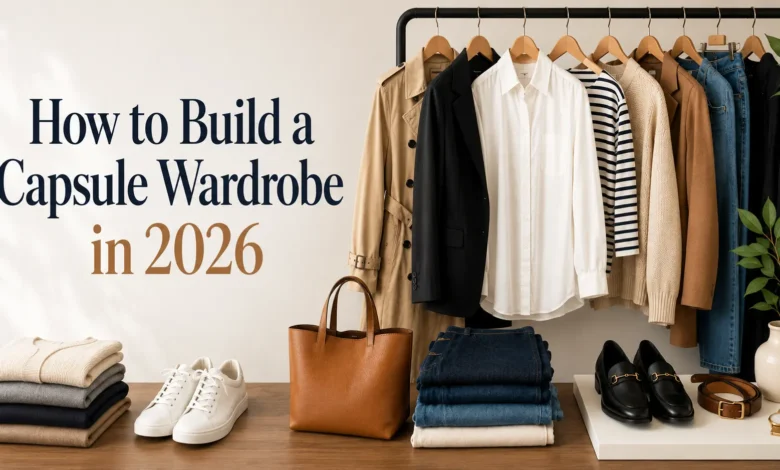
Most people don’t have too few clothes — they have too many of the wrong ones. If you’ve ever stood in front of a full closet and felt like you had nothing to wear, that’s not a quantity problem. That’s a capsule wardrobe problem. This guide walks you through exactly how to build one in 2026: what to keep, what to cut, how many pieces you actually need, and how to do it whether your budget is $150 or $1,500. No vague advice, no shopping lists that require a designer salary.
What a Capsule Wardrobe Actually Is (And Why 2026 Is the Right Time to Build One)
A capsule wardrobe is a small, intentional collection of versatile pieces that work together across multiple outfits — typically 30–40 items including clothing, shoes, and outerwear. The concept has existed since the 1970s, but it’s gaining serious momentum in 2026 for a specific reason: the deinfluencing movement has pushed back hard against fast-fashion haul culture, and more shoppers are consciously choosing fewer, better pieces over constant buying.
Understanding which 2026 trends are worth building into a capsule — and which are micro-trend noise — is covered in full in the “Fashion Trends 2026 complete guide” This article focuses on the build process itself.
How to Build a Capsule Wardrobe: 8 Steps
Step 1: Audit What You Already Own
Before buying a single new piece, pull everything out of your wardrobe and sort it into three piles: keep, donate, and uncertain. The keep pile is for items you’ve worn at least 5 times in the last 12 months and that fit well right now — not aspirationally. The donate pile is for anything worn fewer than twice, anything that doesn’t fit, and anything you’ve kept “just in case” for over a year. The uncertain pile gets a 30-day probation: if you don’t reach for it once in the next month, it goes.
Rule: If you wouldn’t buy it again today at full price, it doesn’t stay.
Step 2: Define Your Actual Lifestyle Ratio
The most common capsule wardrobe mistake is building for the life you want rather than the life you have. If you work from home four days a week but build a wardrobe that’s 60% office-formal, you’ll never feel like you have anything to wear on a Tuesday morning. Map your week honestly: what percentage of your time is casual, smart-casual, work, and occasion wear?
Rule: Your wardrobe ratio should mirror your lifestyle ratio — if 70% of your week is casual, 70% of your capsule should be casual pieces.
Step 3: Choose Your Colour Palette (3 Neutrals + 1–2 Accents)
A capsule wardrobe only works if the pieces mix and match freely. That requires a limited colour palette. Choose 3 neutral base colours (e.g. navy, cream, camel — or black, white, grey) and 1–2 accent colours that work with all three neutrals. Every piece you keep or buy should fit within this palette. A single off-palette item breaks the mixing system and forces you into one-outfit combinations.
Rule: 3 neutrals + maximum 2 accents = every piece pairs with at least 4 others in your wardrobe.
Step 4: Build the Foundation — 10 Non-Negotiable Base Pieces
These are the structural pieces every capsule wardrobe needs regardless of personal style, gender, or budget. They form the base that every other item builds on:
- Well-fitted dark-wash jeans (one pair, no distressing)
- Tailored trousers in a neutral tone
- A white or cream fitted top (cotton, not polyester)
- A plain crew-neck or v-neck knit in your main neutral
- A button-up shirt in white or light blue
- A structured blazer (oversized or fitted — whichever suits your style)
- A versatile dress or skirt (for women) / chinos (for men) in a neutral
- A plain white or grey t-shirt (quality cotton — this gets worn constantly)
- An outerwear piece: trench coat, wool coat, or leather jacket depending on your climate
- One pair of clean, simple, low-profile trainers or loafers
Rule: These 10 pieces should account for roughly 50% of your total outfit combinations. If any one of them is missing, your whole system weakens.
PRO TIP — The Outfit Multiplication Test
Before adding any piece to your capsule, count how many items already in your wardrobe it pairs with. A new piece should combine with at least 5 existing items to justify its place. If it only works with 1 or 2 things you own, it belongs in a different category: it’s a statement piece, not a capsule piece.
Step 5: Add Trend Pieces Selectively (Maximum 20% of Your Total)
A capsule wardrobe doesn’t mean ignoring trends — it means filtering them. Using the 80/20 rule from the [INTERNAL LINK: “Fashion Trends 2026 complete guide” → pillar article URL placeholder], limit trend pieces to a maximum of 20% of your total capsule count. For a 35-piece capsule, that’s 7 trend items. In 2026, the trend pieces most worth building into a capsule (because they have genuine staying power) are oversized structured blazers, suede loafers, and layered gold jewellery. Micro-trend items — a specific viral print, a very particular silhouette tied to one moment — belong outside your capsule if they belong in your wardrobe at all.
Rule: A trend piece earns its capsule spot only if it pairs with at least 5 of your foundation pieces.
Step 6: Fill the Gaps Intentionally, Not Impulsively
After your audit and foundation build, you’ll have a clear picture of what’s genuinely missing. Write a specific gap list — not “more tops” but “one fitted cream knit, one structured belt in brown or tan, one ankle boot in black.” Shop from this list only. The biggest budget leak in wardrobe building is filling emotional gaps (boredom, a sale, a trend moment) instead of functional ones.
Rule: Before any purchase, the item must appear on your gap list by name. If it’s not on the list, it waits 48 hours before you decide.
Step 7: Get One Key Piece Tailored
Off-the-rack clothing almost never fits perfectly — and an ill-fitting piece in a capsule wardrobe is far more visible than in a crowded closet, because it gets worn constantly. Budget $20–$60 per key piece for basic tailoring: taking in a blazer at the waist, hemming trousers to the right break, or shortening sleeves. A $60 blazer that fits perfectly outperforms a $300 blazer that doesn’t in every metric that matters.
Rule: Allocate 10–15% of your total capsule budget to tailoring, not just purchasing.
Step 8: Review Every 6 Months, Not Every Season
A capsule wardrobe isn’t a one-time project — it’s a system that needs a biannual review. Every 6 months (spring and autumn work well as natural transition points), run the same audit from Step 1. Remove anything you haven’t worn at least 4–5 times since the last review. Add a maximum of 3–5 new pieces per review cycle. This keeps the capsule tight and prevents it from slowly drifting back into a cluttered wardrobe over 18 months.
Rule: Maximum 5 new pieces in, minimum 3 old pieces out per 6-month review.
Budget Tiers: Building a Capsule Wardrobe at Every Price Point
Budget Tier ($150–$400 total)
- Focus your spend on the 3 highest-cost-per-wear foundation pieces: a good blazer ($40–$80 second-hand), a quality pair of dark jeans ($30–$60 second-hand or on sale), and one outerwear piece ($50–$120)
- Fill remaining foundation pieces from high-street retailers, sales, and thrift stores — basics (tees, knits, shirts) are where fast fashion is most acceptable because fabric quality matters less for simple cuts
- Reserve $20–$40 for tailoring on your blazer and trousers
Investment Tier ($800–$1,500 total)
- Spend the majority on outerwear, tailored trousers, and your blazer — these are worn the most and visible longest
- Buy basics in quality fabrics: 100% cotton tees ($25–$50 each), merino or cashmere knits ($80–$150), well-constructed denim ($80–$140)
- Budget $100–$200 for tailoring across 3–4 key pieces
- At this tier, cost-per-wear over 3+ years makes the investment rational — a $120 wool coat worn 100 times costs $1.20 per wear
Common Capsule Wardrobe Mistakes
Building for your aspirational life, not your actual one. A capsule full of tailored office pieces doesn’t serve someone who works from home three days a week. Audit your real weekly schedule before deciding your wardrobe ratio — what you wish you did doesn’t count.
Treating “neutral” as synonymous with “beige.” A capsule palette needs contrast to work across multiple outfits. Navy, charcoal, and cream is a neutral palette. All beige is a palette that flattens into one visual tone and makes outfit combinations feel repetitive even when they’re technically different.
Buying capsule pieces at full trend-cycle price. The structural pieces of a capsule wardrobe — blazers, trousers, coats, quality basics — go on significant sale at the end of every season. Buying a wool coat in March rather than October saves 30–50% on the same item.
Skipping the gap list and shopping by feel. Without a specific gap list, every shopping trip becomes an opportunity to add pieces that “kind of work” rather than pieces that genuinely complete the system. A capsule wardrobe built on impulse buys drifts back toward a cluttered wardrobe within one season.
Conclusion
A capsule wardrobe isn’t about having less — it’s about owning only what works. Eight steps, a clear colour palette, and a strict 80/20 split between foundation and trend pieces is enough to build a wardrobe that generates consistent outfits without the daily decision fatigue of sorting through things that don’t belong.
Start with the audit. Everything else follows from knowing what you already have.
Related Reading:
“Budget Capsule Wardrobe Under $300”
“Capsule Wardrobe Essentials for 2026”
“How to Wear Color Without Overdoing It”
For the full picture on which 2026 trends are worth building into your capsule, Full Fashion Trends 2026 guide”
Frequently Asked Questions
How many items should a capsule wardrobe have?
Most capsule wardrobes work best between 30–40 total items, including clothing, shoes, and outerwear but excluding underwear and activewear. Fewer than 25 items starts to feel restrictive for most people’s lifestyles; more than 45 and the “choose anything, it all works” benefit starts to break down.
What is the difference between a capsule wardrobe for women and men?
The foundation pieces are largely the same — quality denim, neutral knits, a structured blazer, a versatile outerwear piece, and simple footwear — but the specific cuts, fits, and proportions differ. Women’s capsules often include one versatile dress or skirt as a foundation piece; men’s capsules typically include chinos or tailored trousers as their second bottom. The palette and outfit-multiplication principles are identical.
Can you build a capsule wardrobe on a tight budget?
Yes — the $150–$400 tier is achievable by prioritising second-hand shopping for structured pieces (blazers, coats, trousers) where fabric quality is high but cost is low, and buying basics new from high-street retailers where construction is consistent. The key is spending money on the items you’ll wear most, not on trend pieces.
How often should you update a capsule wardrobe?
A biannual review — once in spring, once in autumn — is enough for most people. Each review should remove anything worn fewer than 4–5 times in the previous 6 months and add a maximum of 3–5 new pieces. Annual complete overhauls are unnecessary and expensive if the foundation pieces are quality.
Is a capsule wardrobe the same as a minimalist wardrobe?
Not exactly. A minimalist wardrobe prioritises owning as few items as possible as an end in itself. A capsule wardrobe prioritises owning the right items — the goal is outfit versatility and reduced decision fatigue, not a specific item count. A capsule wardrobe of 38 pieces and a minimalist wardrobe of 15 pieces serve different goals, even though they overlap significantly in philosophy.