
Most people own at least one piece of fine jewelry they almost never touch. It was a gift, or a milestone purchase, and it sits in a box because it doesn’t go with anything — too heavy for work, too plain for a wedding, too awkward next to the rest of the drawer. The fix isn’t buying more. It’s buying in a sequence that makes each new piece more useful than the last.
Diamonds are the easiest category to get this right in, because they’re neutral. A white stone in white gold doesn’t clash with navy, rust, olive or black. But neutral doesn’t mean interchangeable: setting height, stone shape, chain length and metal finish all change how a piece behaves against real clothes. Here’s how to think about the pieces that earn their keep.
Start with studs, and get the size wrong on purpose
Diamond studs are the first purchase for a reason — they survive sleep, gym bags, headphones and video calls. The common mistake is buying them a size too large because they look more impressive in the mirror of a jewelry store. In daylight, on an actual ear, an oversized stud tips forward and reads as costume rather than fine.
If you want studs you’ll wear seven days a week, go slightly smaller than your instinct and spend the difference on cut quality. A well-cut stone of modest size throws more light than a bigger, sleepier one, and it sits flatter against the lobe. If you want studs that photograph and announce themselves at events, that’s a second pair, not a compromise on the first.
Settings matter more than you’d expect
- Four-prong martini settings sit low and wide — comfortable under a phone, less likely to snag knitwear.
- Six-prong crown settings lift the stone higher, which catches more light but also more cashmere.
- Bezel and halo-adjacent styles read larger than their stone and are the most forgiving with scarves and high collars.
- Cluster studs give you surface sparkle at a smaller total weight, and they look intentional with daytime clothes in a way a single large solitaire sometimes doesn’t.
Check the back, too. Screw-backs are slower to put on and far less likely to walk off your ear on the subway. Friction backs are quicker but should be replaced when they loosen — a stud that spins freely is a stud about to be lost.
The neckline question nobody asks before buying
Pendants fail for a boring, mechanical reason: chain length. A 16-inch chain sits at the base of the throat and works with crew necks, turtlenecks and open collars. An 18-inch chain lands just below the collarbone and is the safest single choice if you’re only buying one. Anything 20 inches or longer wants a V-neck or an open shirt, or it disappears into fabric.
If you like layering, buy at two different lengths rather than two similar ones — a two-inch gap keeps pieces from tangling and clicking. Put the lighter, finer chain on top and the heavier pendant below, so the weight doesn’t drag the upper strand down. Cross necklaces are a particular case: because the shape is vertical, they read best when the pendant sits in open space rather than against a busy print, and a slightly shorter chain keeps the shape upright instead of sliding sideways.
Tennis bracelets: the piece that changes an outfit fastest
A line bracelet does something studs can’t — it moves. Light runs along it as you gesture, which is why it transforms a plain sweater-and-jeans look more than a necklace of equivalent weight. Two practical notes. First, fit: a tennis bracelet should have roughly one finger of play, enough to slide but not enough to spin to the underside of your wrist. Too loose and the clasp sits where you can see it; too tight and the stones press into skin all day.
Second, the clasp and safety catch are the whole investment. Ask how the bracelet closes, whether there’s a secondary figure-eight catch, and how the links articulate. A bracelet with stiff links lies awkwardly on a narrow wrist. Finer-stone bracelets in 14K or 18K white gold stack comfortably with a watch; chunkier ones compete with it and are better worn on the opposite arm.
Where color earns its place
Once the white-diamond basics are covered, color is the most interesting next step — and the most personal. Fancy color diamonds and gemstone accents such as emerald, ruby or sapphire give you a piece that does a job no colorless stone can: it ties into a palette. Emerald next to camel and cream, sapphire next to denim and grey, ruby against black or deep green. The trick is to treat a colored piece as the focal point and keep everything else white or metal-only, so the eye has somewhere to land.
If you want a framework for building up gradually instead of buying in bursts, the idea of a jewelry capsule wardrobe is a genuinely useful one — a small, deliberate set of pieces that recombine, rather than a drawer of one-offs.
Doing the homework before you commit
Earrings are where most buyers have the least information and the most at stake, because small differences in cut and setting show up immediately at eye level. Reading through a proper diamond earrings guide before you shop is worth the twenty minutes — the ones published by specialist retailers like Leon Diamond, whose collections run from solitaire and cluster studs to heart and clover motifs, gemstone-accented squares and fancy color diamond pieces, tend to explain the trade-offs between stone size, setting style and certified diamond quality in plain terms. Having a showroom in New York’s diamond district helps on the other side of the process too: seeing two pairs side by side under the same light settles questions that photographs can’t, and if you’re buying online with shipping, knowing what to ask about certification and returns beforehand saves the back-and-forth later.
Make the pieces work with what you already own
A diamond wardrobe only functions if it maps onto your actual closet. Before adding a piece, look at what you wear on a normal Tuesday and on the three or four occasions a year that call for something more. If your daily uniform is high necklines, a pendant will lose to a pair of studs every time. If you wear a lot of sleeveless and short sleeves, a bracelet earns far more hours than a necklace. Thinking about how to match jewelry to the outfits you actually reach for is a more reliable filter than any trend report.
A sensible order of purchase
- Everyday studs, well cut, slightly smaller than you first wanted.
- One 18-inch pendant — solitaire or cross, depending on what you’ll wear without thinking.
- A line bracelet, fitted properly, with a secondary catch.
- A larger or more decorative pair of earrings for occasions.
- One colored piece, chosen to work with the colors already in your wardrobe.
Keeping them looking new
Diamonds attract grease, and skin oil dulls them faster than scratches ever will. Warm water, a drop of dish soap and a soft toothbrush once a week restores most of the lost brilliance. Put jewelry on last when dressing and take it off first — hairspray and lotion leave a film that builds up around prongs. Have bracelet clasps and stud backs checked periodically; a five-minute tightening is the cheapest insurance in fine jewelry. Pieces that are easy to clean and comfortable to wear are the ones that leave the box, and the ones that leave the box are the only ones that were ever worth buying.
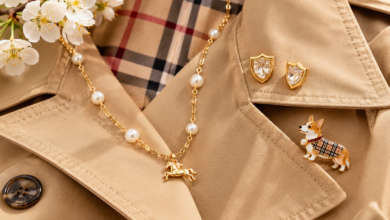
If you love adding elegant designer accessories to your jewelry collection, explore our guide to Burberry Spring Jewellery: 5 Stunning Pieces to Adore for inspiration on timeless necklaces, statement earrings, and stylish bracelets.