Every “capsule wardrobe essentials” list on the internet looks the same: a white tee, some jeans, a blazer. That’s not wrong — but it’s not enough. What those lists skip is the harder question: which version of those pieces actually works in 2026, which ones from your existing wardrobe are still pulling their weight, and which trend items are genuinely worth adding versus which ones will feel dated by summer. This article answers all three — specifically, with numbers, and without the vague advice that fills most wardrobe guides.
Where Capsule Essentials Fit in the Bigger 2026 Picture
A capsule wardrobe essentials list is not a shopping list — it’s a filter. It tells you what categories of pieces your wardrobe needs to function, and then helps you evaluate what you already own against that standard. The broader context of what’s trending in 2026 — which silhouettes, colours, and fabrics are worth building into a long-term wardrobe versus which are short-cycle micro trends — is covered in the [INTERNAL LINK: “Fashion Trends 2026 complete guide” → pillar article URL placeholder]. This article focuses on the specific pieces: what stays, what gets added, and what gets cut.
The Capsule Wardrobe Essentials for 2026: What to Keep, Buy, and Skip
This article uses Guide Format (B) — organised by clothing category, with a Keep / Buy / Skip verdict and concrete criteria for each decision.
Tops: The Foundation Nobody Gets Right
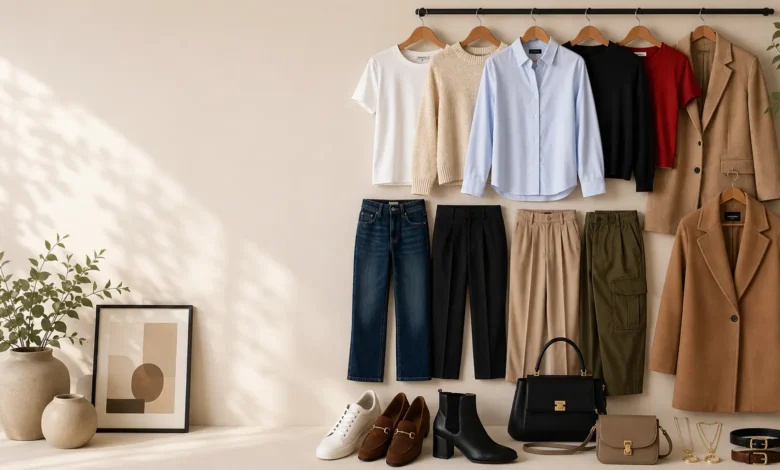
Tops are the most over-owned category in most wardrobes and the easiest place to lose the plot. The goal is 6–8 tops total in a functioning capsule: roughly 3 basics, 2 smart-casual options, and 1–2 trend pieces.
The 5-Wear Rule: any top that hasn’t been worn 5 times in the last 6 months gets cut, regardless of how much it cost or how much you liked it when you bought it.
- Keep a plain white or cream fitted tee in 100% cotton — if it’s pilling, has gone grey, or has lost its shape, replace it rather than keeping it out of habit. This piece gets worn more than almost anything else.
- Keep any quality knit (merino, cotton-modal blend) in a neutral tone — navy, oatmeal, charcoal — that sits close to the body without clinging. Oversized knits that don’t have a defined structure tend to make outfits look unfinished rather than relaxed.
- Buy one structured button-up in white or pale blue if you don’t own one that still fits well. A well-cut shirt bridges casual and smart-casual in a way almost nothing else does.
- Buy one top in a 2026 punchy colour — cherry red, cobalt, or deep terracotta — in the simplest possible cut (fitted tee or plain knit). One colour pop, maximum versatility.
- Skip graphic tees unless they’re genuinely personal to you — they date quickly and limit outfit combinations. Also skip anything in a synthetic fabric (polyester-dominant blends) at the basics level; they pill, retain odour, and look cheap after 10 washes.
Bottoms: Where Most People Under-Invest
Most capsule wardrobe advice recommends 4–5 bottoms: 2 pairs of trousers/jeans, 1 tailored option, and 1–2 skirts or casual alternatives depending on your lifestyle. The 2026 update is about quality over quantity more than silhouette shift.
The Cost-Per-Wear Bottom Test: divide the price of any bottom by the number of times you realistically expect to wear it per year, multiplied by 3 years. A $120 pair of jeans worn 80 times per year over 3 years costs $0.50 per wear. A $40 pair worn 10 times and discarded costs $4.00 per wear.
- Keep any well-fitted dark-wash jeans with no distressing — dark denim is the most versatile bottom in a capsule because it reads both casual and smart-casual depending on what’s paired with it.
- Keep tailored trousers in a neutral (camel, charcoal, navy, or cream) if they still fit through the waist and hip without pulling. If the fit is off, alter rather than replace — a $25 waist alteration extends a good pair of trousers by years.
- Buy wide-leg or straight-leg trousers in a neutral if you don’t own a tailored option — this is the silhouette with the longest runway in 2026 and the most outfit versatility across the rest of the capsule.
- Buy one pair of cargo or utility-style trousers in a muted tone (olive, stone, or charcoal) only if your lifestyle is predominantly casual. They’re a genuine 2026 trend with staying power, but they don’t substitute for a tailored trouser in smarter contexts.
- Skip very cropped wide-leg jeans (the ultra-short inseam version) — the proportion only works in a narrow range of outfit combinations and is already showing signs of being a short-cycle trend. Also skip anything in a novelty fabric (coated denim, faux leather trousers as an everyday piece) unless occasion-specific.
Outerwear: The Highest Cost-Per-Wear Category You Own
A single quality outerwear piece worn daily through a 5-month season gets roughly 100–150 wears per year. At that volume, outerwear has the lowest cost-per-wear of anything in your wardrobe — which makes it the single most justifiable place to spend real money.
The One-Coat Rule for Capsules: most capsules need exactly one primary outerwear piece and one secondary (a lighter jacket or transitional layer). Owning 6 coats is a wardrobe, not a capsule.
- Keep any wool or wool-blend coat in a neutral that still fits through the shoulders — shoulder fit on a coat cannot be altered cheaply. Everything else (length, waist, sleeve) can be adjusted for $30–$60.
- Keep a leather or leather-look jacket if you own one that works with at least 5 pieces in your current wardrobe.
- Buy a structured trench coat in camel, stone, or black if your current primary coat is heavily casual — a trench is the most cross-functional outerwear piece in a capsule because it works over both tailored and casual outfits.
- Skip overly trend-specific outerwear: shearling-everything, very oversized puffer silhouettes, and heavily embellished coats all limit outfit pairings and date faster than neutral, structured options.
PRO TIP — The 2026 Outerwear Upgrade That Costs Nothing
Before buying new outerwear, try your existing coat with the 2026 silhouette: a structured blazer underneath a trench or wool coat, worn open, immediately updates a classic piece without spending anything. The layered tailoring look is one of the strongest 2026 styling directions and works with outerwear you already own.
Footwear: Three Pairs, Maximum Functionality
A capsule wardrobe needs exactly 3 footwear categories covered: a casual everyday option, a smart-casual option, and an occasion or weather-specific option. More than 5–6 pairs in active rotation is no longer a capsule — it’s a shoe collection.
The Three-Pair Coverage Test: your footwear should cover at least 90% of your weekly outfit needs across those three categories. If you reach for shoes that fall outside your capsule more than once a week, your three chosen pairs aren’t right.
- Keep any clean, low-profile trainers (sneakers) in white, grey, or black — provided they’re not visibly worn down. Worn-out trainers downgrade every outfit they’re paired with, including expensive ones.
- Keep loafers (leather, suede, or leather-look) if you own a pair — suede loafers in particular are one of the strongest 2026 footwear directions and work across casual and smart-casual outfits equally.
- Buy suede or leather loafers if you don’t own a smart-casual flat option — this is the 2026 footwear investment with the clearest cost-per-wear payoff.
- Buy one ankle boot in black or tan if your climate requires it — a clean, heeled or flat ankle boot covers smart-casual to occasion wear across autumn and winter.
- Skip very trend-specific footwear as capsule pieces — ultra-platform trainers, ballet flats with extreme embellishment, and very pointed-toe kitten heels all have narrow outfit compatibility and shorter trend cycles.
Accessories: The 2026 Update That Doesn’t Require New Clothing
Accessories are where 2026’s biggest trend — layered gold jewellery, structured bags, and texture-rich details — is most accessible, because adding or updating an accessory changes the read of an entire outfit without requiring a new garment.
The Rule of Three for Capsule Accessories: own 3 bags (one everyday, one structured/work-appropriate, one occasion), 3 jewellery pieces that work as a set (a necklace, earrings, and ring or bracelet), and 2 belts (one casual, one structured). Beyond this, accessories become collection rather than capsule.
- Keep any structured bag in a neutral tone that isn’t visibly worn — a bag in regular rotation shows wear quickly, and a scuffed or misshapen bag undermines otherwise polished outfits.
- Buy layered gold-tone necklaces (2–3 at different lengths) if you don’t own jewellery that can be worn in multiples — this is the single most accessible 2026 trend to incorporate, starting at $15–$40 for quality-looking pieces.
- Skip heavily branded or logo-forward accessories as capsule staples — logos date, go in and out of trend cycles, and limit the neutral mixing system a capsule depends on.
Budget Tiers: Building or Refreshing Your Capsule Essentials
Budget Tier ($100–$300 for a refresh, not a full rebuild)
- Prioritise replacing worn-out basics first: a plain white tee ($15–$30), a quality knit ($30–$60 on sale or second-hand), and one footwear update if needed
- Source structured pieces (blazers, trousers, outerwear) second-hand — these are the categories where quality is highest and price is lowest in the resale market
- Hold off on trend pieces until basics are solid — a cherry-red top means nothing if the white tee underneath it has gone grey
Investment Tier ($400–$900 for targeted upgrades)
- Spend on outerwear first (wool coat $150–$300), then footwear (quality loafers $80–$180), then tailored trousers ($80–$150)
- At this tier, fabric quality becomes the differentiator — 100% wool, merino, and full-grain leather outlast synthetic alternatives by 3–5x in both appearance and durability
- Budget $60–$100 for tailoring on 2–3 key pieces; a well-fitted $180 coat outperforms a poorly fitted $400 one in every context
Common Capsule Essentials Mistakes
Keeping pieces “just in case” they come back into style. Trend cycles are not predictable enough to justify storing unworn items for 2–3 years on the chance they resurface. If something hasn’t been worn in 12 months, it’s occupying physical and mental space that a working capsule piece should fill.
Confusing “neutral” with “works with everything.” A beige knit and camel trousers are both neutrals, but they clash in tone rather than complement each other. Neutrals need contrast to work — pair warm neutrals (camel, cream, tan) with cool ones (charcoal, navy, white) to create combinations that read as intentional rather than washed out.
Updating accessories before fixing fit on clothing. No amount of layered gold jewellery fixes a blazer that pulls across the shoulders or trousers that bunch at the waist. Tailoring existing pieces delivers more visible improvement per dollar than any accessory purchase.
Treating the essentials list as a shopping list. The point of a capsule essentials framework is to evaluate what you already own first — most people have 60–70% of what they need and are buying to fill emotional rather than functional gaps. Audit before you shop, every time.
Conclusion
The keep / buy / skip framework isn’t about owning less for its own sake — it’s about making sure every piece in your wardrobe is actively working. Apply the 5-Wear Rule to tops, the Cost-Per-Wear Test to bottoms, and the Three-Pair Coverage Test to footwear, and the decisions largely make themselves.
Start with what you already own. Most capsule wardrobes need an edit more than a shopping trip.
Also Read: “How to Build a Capsule Wardrobe step by step“
Frequently Asked Questions
A capsule wardrobe is a small, intentional collection of versatile clothing pieces that work together across multiple outfits — typically 30–40 items including clothing, shoes, and outerwear. The defining feature isn’t the item count but the compatibility: every piece should pair with at least 4–5 others in the same wardrobe.
The non-negotiable foundation pieces remain consistent year to year — quality dark-wash jeans, a structured blazer, a neutral knit, a plain white tee, tailored trousers, and one outerwear piece. The 2026 update is in the details: suede loafers over chunky trainers, layered gold jewellery over statement single pieces, and one punchy-colour top (cherry red or cobalt) over the all-neutral approach of previous seasons.
The category structure is identical — tops, bottoms, outerwear, footwear, accessories — but the specific pieces differ in cut and proportion. Women’s essentials typically include a versatile dress as a foundation item; men’s replace that with a second trouser option (chinos or tailored trousers alongside denim). The keep / buy / skip logic and cost-per-wear principles apply equally to both.
Use the 5-Wear Rule: any piece worn fewer than 5 times in the last 6 months gets cut or goes into a 30-day probation period. For fit, apply the shoulder test to structured pieces — if the shoulder seam sits correctly, the rest can be tailored cheaply. If the shoulder is off, the piece needs replacing rather than altering.
The core categories don’t change — quality basics, a structured layer, versatile footwear, and a neutral palette are consistent across years. What changes is which version of those categories is most current: silhouette shifts (wide-leg vs. tapered), material preferences (suede vs. leather), and which accent colours work best against the season’s dominant neutrals. In 2026, the updates are incremental rather than dramatic.
Also Read: Fashion Trends 2026: The Complete Guide to What’s In, What’s Out, and How to Actually Wear Them