Most people who say they “can’t wear color” aren’t afraid of color — they’re afraid of getting it wrong. Too much, too bright, too costume-y. The result is a wardrobe that defaults to black, grey, and navy not out of preference but out of avoidance. This article fixes that with one rule and seven practical applications: how to introduce color into any outfit, at any confidence level, without it reading as overdone. By the end, you’ll have a clear formula — not vague encouragement.
Color and the 2026 Fashion Moment
2026 is a punchy-color year. Cherry red, cobalt blue, and bubblegum pink are showing up across every price point and silhouette — but the way they’re being worn matters as much as which colors are trending. The dominant styling direction is one bold piece against a neutral base, not head-to-toe color blocking. Understanding how that fits into the broader 2026 trend picture — which colors have macro staying power versus micro-trend shelf life — is covered in the [INTERNAL LINK: “Fashion Trends 2026 complete guide” → pillar article URL placeholder]. This article is about the mechanics of wearing color well, whatever the shade.
How to Wear Color Without Overdoing It: 7 Rules
Rule 1: The One-Punch Rule — One Color Statement Per Outfit
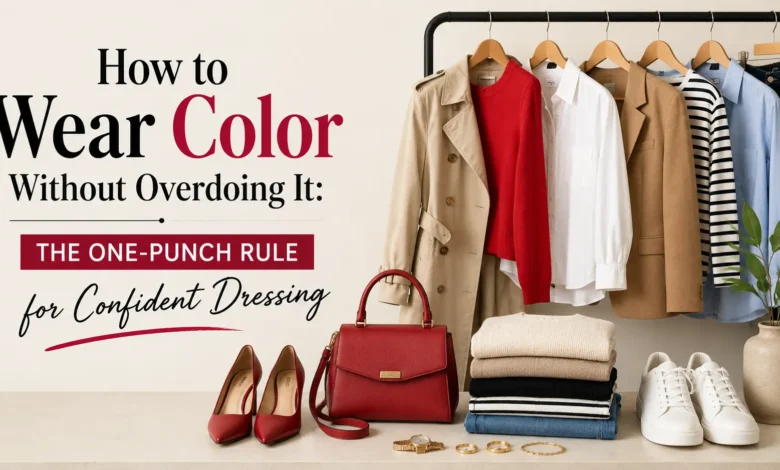
The single most reliable rule for wearing color confidently is also the simplest: one punchy-colored item per outfit, everything else neutral. One cherry-red top with dark jeans and white trainers reads as styled. A cherry-red top with cobalt trousers and an orange bag reads as costume. The One-Punch Rule works because it gives the eye one place to land — the colored piece becomes intentional rather than chaotic.
The rule in numbers: 1 color statement + minimum 2 neutral pieces = a color outfit that works. The moment you introduce a second non-neutral color, you need a genuine understanding of color theory to make it work — and most everyday dressing doesn’t require that level of effort.
Rule 2: Start With Accessories, Not Garments
If you’re new to wearing color or rebuilding confidence after years of neutrals, accessories are the lowest-risk entry point — and the easiest to reverse if you change your mind. A cobalt bag, a cherry-red belt, or a pair of colored shoes costs less than a garment, requires no tailoring, and can be swapped out of any outfit in 30 seconds. Accessories also let you test whether a specific color actually works with your existing neutral wardrobe before committing to a full top or trouser in that shade.
Rule: Before buying a colored garment, own the accessory version first. If you reach for the colored bag consistently over 4 weeks, the garment investment is justified. If it sits unworn, you’ve saved yourself $60–$150 on a top you’d never wear.
Rule 3: Match Color Intensity to Occasion
Not all colors sit at the same intensity level, and context matters. A saturated cobalt blue in a workwear context needs a quieter outfit around it than the same color at a weekend brunch. The principle is simple: the more formal or conservative the context, the more the rest of the outfit needs to pull back to let one color piece work. In a business-casual office environment, a colored top works; a colored trouser paired with a colored top in a different shade is harder to pull off without looking unintentional.
Rule: Formal context = 1 colored piece, everything else in your most neutral neutrals. Casual context = 1 colored piece, neutrals can be warmer or more textured. The color piece stays constant; the neutrals around it flex.
Rule 4: Understand Warm vs. Cool — Your Neutrals Must Match Your Color’s Undertone
This is where most color outfits go wrong without the wearer knowing why. Colors have undertones — warm (yellow-based) or cool (blue-based) — and they need to be paired with neutrals that share that quality. Cherry red is warm; it pairs with camel, cream, tan, and off-white. Cobalt blue is cool; it pairs with charcoal, white, and navy. Pair a warm color with a cool neutral — cherry red with charcoal grey, for instance — and the outfit reads as slightly off without being obviously wrong. Pair it correctly and the combination looks deliberate.
Rule: Warm colors (red, orange, yellow, warm pink) → pair with warm neutrals (camel, cream, tan, warm white). Cool colors (cobalt, emerald, burgundy, blush) → pair with cool neutrals (white, charcoal, grey, navy). When in doubt, white and dark navy are the most neutral of all neutrals and work with almost every color.
PRO TIP — The Mirror-and-Wait Test
When you put on a color outfit and feel uncertain, don’t change immediately. Walk away for 5 minutes, then look again. The initial discomfort with wearing color is almost always about unfamiliarity, not about the outfit being wrong. If it still reads as too much after 5 minutes, remove one colored piece. If it looks fine after 5 minutes, you’ve just expanded your comfort zone — wear it.
Rule 5: Use Color in Simple Cuts, Not Complex Ones
A bold color in a simple cut (a plain fitted tee, a straight-leg trouser, a clean A-line skirt) reads as intentional. The same color in a complex cut — heavy draping, ruffles, cut-outs, oversized volume — reads as overwhelming, because the color and the silhouette are both competing for attention simultaneously. When you’re introducing color into an outfit, simplify the cut. Save complex silhouettes for neutral pieces where the structure itself is the statement.
Rule: Colored piece = simplest cut you own in that category. Complex silhouette = your most neutral color. Never both at once.
Rule 6: The 3-Outfit Test Before You Buy
Before buying any colored piece, picture 3 specific outfits you’d build around it using clothes you already own. Name the pieces: “grey tailored trousers, white tee, and white trainers” is a real outfit. “Something casual” is not. If you can’t picture 3 complete outfits with items you currently own, the piece has limited versatility in your actual wardrobe regardless of how good it looks on the hanger. This is particularly important for colored pieces because they’re inherently less flexible than neutrals.
Rule: 3 named outfits using existing pieces = justified purchase. Fewer than 3 = wait, or reconsider.
Rule 7: Can You Wear Color to a Funeral or Black Tie Event?
These are the two most-searched context questions around wearing color — and both have clear answers.
Funerals: In most Western contexts, color is acceptable at a funeral provided it’s muted and respectful rather than bright and festive. Dusty rose, muted sage, soft navy, and deep burgundy are all worn at funerals without issue. What to avoid: saturated brights (cobalt, cherry red, electric yellow), loud prints, and anything that reads as celebratory rather than respectful. In some cultural traditions, specific colors (white in some South Asian traditions, for example) are worn as the primary mourning color — context and family preference always override general guidance.
Black tie: Yes, color absolutely works at black tie events — in fact, a colored gown or a statement-colored suit is often more appropriate than basic black at a formal occasion. The rule at black tie is about fabric quality and formality of cut, not about color avoidance. A floor-length gown in cobalt or emerald reads as more formal than a poorly cut black dress. For men, a colored bow tie or pocket square against a black or navy tuxedo is the cleaner approach than a full colored suit jacket, unless the event is explicitly fashion-forward.
Also Read: How to Build a Capsule Wardrobe in 2026: The Step-by-Step Guide for Every Budget
Budget Tiers: Trying Color at Every Price Point
Low-commitment tier ($15–$60)
- A colored tote or crossbody bag in this season’s key color — tests whether the color works in your wardrobe before a garment investment
- A plain fitted tee in cherry red, cobalt, or your chosen accent color — basics in color are the lowest cost-per-wear entry point
- A colored belt in a simple leather or faux-leather finish: under $30, pairs with 80% of neutral outfit combinations
Investment tier ($80–$200)
- A quality knit in your chosen accent color — merino or cotton-modal blend at $80–$140 lasts 4–5 seasons and gets worn constantly across autumn and winter
- A structured trouser in a 2026 trend color (deep burgundy, cobalt, or forest green) — higher commitment but high outfit versatility when paired against neutral tops
- A leather or suede bag in a punchy accent color: $100–$200 for quality that outlasts a fast-fashion garment by years
Common Color-Wearing Mistakes
Wearing color in the wrong undertone for your existing neutrals. A warm cherry red with a cool grey creates visual tension that’s hard to identify but immediately noticeable. Before buying any colored piece, check which neutrals you already own most of — warm or cool — and buy colors that share that undertone quality.
Buying color in the same cut you already own in neutrals. If you own a fitted crew-neck tee in white and grey and you add cherry red, that’s a capsule addition. If you own a draped, oversized blouse in white and add the same silhouette in cobalt, the complexity compounds rather than adding variety. Use color in simple cuts, not statement ones.
Treating “wearing color” as a personality commitment. Some people resist color because they feel it signals something about who they are — that they’re a “colorful person” now. One red top is not an identity. It’s a top. The One-Punch Rule works specifically because it keeps color as one element of an outfit rather than the whole statement.
Buying multiple colored pieces at once. A common pattern after deciding to wear more color: buying a red top, cobalt trousers, and an orange bag in the same shopping session. Each piece individually might work; together they don’t mix, and the buyer ends up with three one-outfit items instead of three versatile pieces. Buy one colored piece, wear it 5+ times, then decide what the next addition should be.
Also Raed: Capsule Wardrobe Essentials 2026: What to Keep, What to Buy, and What to Skip
Conclusion
The One-Punch Rule works because it removes the decision: one color statement, everything else neutral, correct undertone match. That’s the whole system. Apply it with accessories first, graduate to garments once you’ve confirmed the color works with your existing wardrobe, and keep the cut simple when the color is bold.
Color isn’t complicated. It just needs one clear rule to stop feeling overwhelming.
Frequently Asked Questions
Use the One-Punch Rule: one colored piece per outfit, with everything else in neutrals. The colored piece becomes the focal point rather than competing with other elements. Keep the cut of the colored piece simple — a plain fitted top or straight-leg trouser — so the silhouette doesn’t add a second layer of complexity on top of the color.
Start with colors that sit closer to neutrals on the spectrum: burgundy, forest green, and deep navy are punchy enough to read as a color choice but conservative enough to pair easily with most existing wardrobe pieces. Cherry red and cobalt blue are bolder but highly versatile against black, white, and camel. Avoid starting with yellow or orange — both require more precise undertone matching to work against most neutral wardrobes.
Yes, in most Western contexts — provided the color is muted and respectful rather than bright or festive. Dusty rose, soft navy, muted sage, and deep burgundy are appropriate. Avoid saturated brights like cherry red, cobalt, or electric yellow. Cultural and family preferences always take precedence over general guidance, so when in doubt, opt for the more conservative choice.
Yes — color at a black tie event is entirely appropriate and often more considered than default black. The key is formal fabric and cut, not color avoidance. A floor-length gown in emerald or cobalt reads as formal; a poorly cut cocktail dress in black does not. For men, a colored tie or pocket square against a black tuxedo is the cleaner approach unless the event is explicitly fashion-forward.
Start with one accessory in your chosen accent color — a bag, a belt, or a shoe — and wear it consistently for 3–4 weeks before buying a garment in the same color. This tests whether the color actually works with your existing neutral pieces before a larger investment. Once you’ve confirmed it works, a plain fitted top in that color is the most versatile garment entry point.
Also Read: Fashion Trends 2026: The Complete Guide to What’s In, What’s Out, and How to Actually Wear Them