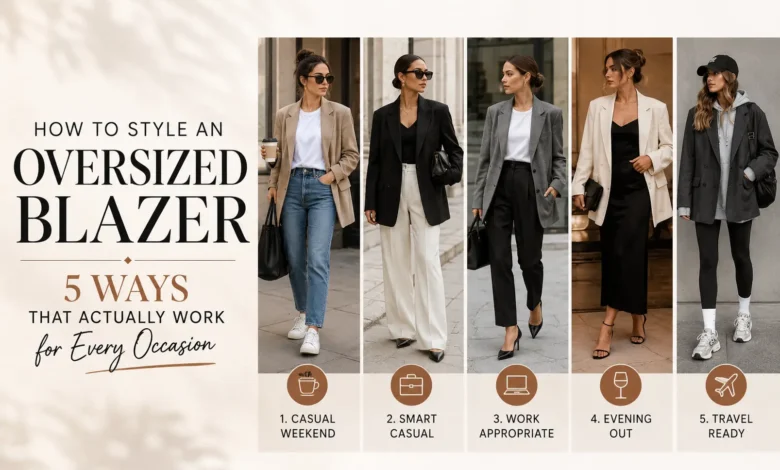
An oversized blazer is one of the most searched wardrobe pieces online — and one of the most inconsistently styled. The problem isn’t finding outfit ideas; there are thousands of them. The problem is that most styling guides show you a finished look without explaining the mechanics that make it work: why that specific proportion functions, what’s actually happening at the shoulder and hem, and how to replicate the result with pieces you already own. This article covers 5 complete outfit formulas, the proportion rules that underpin each one, how to adapt them across occasions, and the fit checks that separate a deliberately oversized blazer from one that simply looks too big.
The Oversized Blazer in 2026: Why This Piece Has Real Staying Power
The oversized blazer isn’t a micro-trend. It’s been building across multiple seasons and is now one of the defining silhouette directions of 2026 — part of the broader shift toward ’80s-coded power dressing that’s showing up across runways and high street retailers simultaneously. What makes it a genuine capsule investment rather than a trend experiment is its range: the same blazer can read as weekend-casual, smart-casual, work-appropriate, or evening-ready depending entirely on what’s paired with it and how it’s proportioned. The full context of how the oversized blazer fits into 2026’s biggest silhouette and styling trends is covered in the “Fashion Trends 2026 complete guide“. This article is about the practical mechanics of making it work across five real-world occasions.
Before the 5 Ways: The Fit Check Every Oversized Blazer Needs
Most styling guides skip this entirely — which is why readers try the outfits and they don’t work. The single biggest variable in oversized blazer styling isn’t the outfit formula; it’s whether the blazer is the right kind of oversized. There are two types:
Intentionally oversized: the blazer is designed with deliberate proportions — the shoulder seam sits 1–2 inches off the natural shoulder, the body has volume and length but the lapels and chest are structured. This type photographs well, drapes intentionally, and can be worn multiple ways.
Accidentally too big: the blazer is simply a larger size in a standard cut — the shoulder seam drops too far (more than 2.5 inches past the natural shoulder point), the chest collapses rather than holding structure, and the sleeves cover the hands without the cuff folding cleanly. This type reads as borrowed, not oversized.
The three-point fit check before styling:
- Shoulder seam: should sit 1–2 inches off your natural shoulder. If it drops past 2.5 inches, the blazer is too large rather than intentionally oversized.
- Chest structure: the lapels should lie flat without gaping. If the chest collapses when you stand straight, the blazer needs the next size down.
- Sleeve length: the sleeve should hit at or just below the wrist when unbuttoned. When rolled or pushed up, it should stay in place rather than sliding down. If it covers your knuckles while flat, it’s too long for intentional styling.
If a blazer passes all three checks, it’s a workable oversized blazer. If it fails two or more, no styling formula will make it look intentional — it needs to be a size down.
Also Read: How to Wear Color Without Overdoing It: The One-Punch Rule for Confident Dressing
The 5 Oversized Blazer Outfits: Complete Formulas
Way 1: The Blazer-as-Outerwear Formula (Casual, Weekend)
The occasion: weekend errands, casual brunch, daytime social, creative-office casual Friday.
The most versatile application of an oversized blazer is treating it as the outermost layer of a casual outfit — replacing a jacket rather than functioning as tailoring. This works because the blazer’s structure elevates whatever’s underneath it without requiring the pieces below to do any heavy lifting.
The formula:
- Base layer: fitted white or cream tee (100% cotton, not sheer — sheer fabrics lose their shape under a structured blazer and create a messy silhouette at the neckline)
- Bottom: straight-leg or wide-leg dark-wash jeans, or tailored wide-leg trousers in a neutral
- Blazer: worn open, no belt, sleeves pushed up once to expose the forearm
- Footwear: clean white low-profile trainers or suede loafers
- Bag: one structured tote or crossbody in a contrasting texture (leather or suede against the smooth blazer fabric)
The proportion rule: when the blazer is worn as outerwear over a tee and jeans, the bottom should be slim or straight rather than wide. If the blazer is boxy and the trousers are wide, the entire silhouette reads as shapeless. One wide element (the blazer) needs one narrower element (the trouser or jean) to create proportion.
The one adjustment that changes everything: push the sleeves up to just below the elbow rather than leaving them at full length. Full-length sleeves on an oversized blazer in a casual context read as formal. Pushed-up sleeves immediately shift the read to relaxed and intentional.
Colour application: a neutral blazer (camel, charcoal, cream, black) over a white tee and dark denim is the cleanest version of this formula. To apply the 2026 colour direction, swap the tee for one in a punchy colour — cherry red or cobalt — and keep the blazer and bottom in neutrals. The [INTERNAL LINK: “How to Wear Color Without Overdoing It” → color styling guide] covers this in full.
Way 2: The Power-Dressing Formula (Work, Smart-Casual)
The occasion: office environment, client meetings, smart-casual work settings, formal creative industries.
This is the 2026 trend application of the oversized blazer — the ’80s-coded power dressing silhouette that’s leading this year. It works by leaning into the blazer’s structure rather than softening it: sharp shoulders, tailored trouser, minimal accessories.
The formula:
- Base layer: a silk or satin cami, a fitted fine-knit top, or a crisp button-up shirt (tucked in)
- Bottom: tailored wide-leg or straight-leg trousers in a matching or tonal neutral — not jeans
- Blazer: worn open or with one button fastened at the waist; NOT belted in this formula (belting softens the power-dressing silhouette)
- Footwear: a pointed or almond-toe flat, a low heel, or a clean loafer — NOT a trainer in this context
- Accessories: gold jewellery — one layered necklace or a pair of structured earrings; a structured bag in leather or leather-look
The proportion rule: in the power-dressing formula, the blazer and trousers should share tonal proximity even if not matching exactly. A charcoal blazer with black trousers and a white shirt is the simplest version. A camel blazer with cream trousers is warmer and slightly more relaxed but still reads as intentional tailoring. Where this formula breaks: a blazer and trouser in clearly different tones (a navy blazer with brown trousers) reads as mismatched rather than mixed.
The shoulder detail: the ’80s power-dressing shoulder — structured and slightly padded — is the element that makes this formula read as 2026-current rather than generic. If your blazer has minimal shoulder structure, you can add a thin shoulder pad insert (available at most fabric and tailoring shops for under $10) to update the silhouette without buying a new blazer.
For men: the same formula applies — oversized or slightly relaxed blazer over tailored trousers, with a fitted shirt underneath. The key difference is that men’s oversized blazers work better with a slight taper at the waist (one button fastened) rather than fully open, to maintain proportion against the trouser line.
Way 3: The Blazer-as-Dress Formula (Evening, Smart-Casual Evening)
The occasion: evening out, dinner, date night, smart-casual event, drinks after work.
The oversized blazer worn as a dress — with nothing underneath but a belt at the waist — is one of the most-searched styling approaches and one of the most inconsistently executed. When it works, it’s one of the highest-impact single-piece outfits possible. When it doesn’t, it reads as unfinished or accidental. The difference is almost entirely in the belt and the footwear.
The formula:
- Blazer: worn as the only top-and-bottom garment, belted at the natural waist with a structured belt (leather or leather-look, 1–1.5 inches wide)
- Underneath: either bare legs, sheer or opaque tights depending on season and temperature, or a pair of cycling shorts or mini skirt in the same colour as the blazer to ensure coverage while maintaining the dress silhouette
- Footwear: a heeled boot, a strappy heel, or a pointed-toe flat — the footwear needs to have an evening register; trainers break this formula entirely
- Bag: a small clutch or mini crossbody — a large tote competes with the minimal silhouette
- Jewellery: this formula reads best with one statement piece — an earring, a layered necklace, or a stacked ring — rather than multiple accessories
The proportion rule: the belt placement is everything in this formula. The belt must sit at the natural waist — the narrowest point of the torso — not at the hip. Belt at the hip and the blazer reads as a shapeless top, not a dress. Belt at the natural waist and the blazer immediately takes on a defined, dress-like structure.
Length check: for this formula to work, the blazer needs to hit at or below mid-thigh. A blazer that ends at the upper thigh is too short to read as a dress silhouette and too long to read as a top — it sits in an in-between zone that looks unresolved. If your blazer hits at the upper thigh, this formula isn’t the right application for it — use Way 1 or Way 2 instead.
PRO TIP — The Coverage Test
Before wearing the blazer-as-dress formula out, do the sit-down test. Sit in the blazer belted, with whatever you’re wearing underneath, and check coverage. If the hem rides up past a point you’re comfortable with when seated, add a pair of bike shorts or a mini slip skirt in a matching colour underneath. Dark under darker: black bike shorts under a black or charcoal blazer are completely invisible standing and provide full coverage seated. This solves the practical problem without changing the visual of the outfit from standing height.
Way 4: The Layered Formula (Transitional Season, Smart-Casual)
The occasion: spring and autumn dressing, layered office looks, travel outfits, any context where temperature varies across the day.
The layered formula treats the oversized blazer as a middle layer rather than an outer layer — worn over a knit, a hoodie, or a lighter jacket and under a coat when temperatures drop. This is the application most styling guides skip entirely, which is why most people don’t think to reach for their blazer during transitional seasons.
The formula:
- Inner layer: a fine knit (merino or cotton-modal) in a neutral tone, a fitted turtleneck, or a lightweight hoodie in a colour that works with the blazer
- Blazer: worn over the knit, open, with the inner layer visible at the neckline and cuffs
- Bottom: straight-leg trousers, wide-leg denim, or a midi skirt
- Footwear: ankle boots or loafers — both work with midi and trouser lengths equally
- Outer layer (if needed): a longline coat worn open over the blazer
The proportion rule for layering: the inner layer must be slim-fitting. An oversized knit under an oversized blazer adds bulk on bulk and eliminates the structure the blazer is supposed to provide. The inner layer’s job is warmth and a visible contrast at the neckline and cuffs — not volume. A fitted turtleneck or a fine-knit crew neck visible at the neckline creates a layered look that reads as intentional. A thick chunky knit underneath creates a silhouette that reads as too large.
The texture opportunity: this formula is the best application of the 70/30 texture rule in blazer styling. A smooth wool blazer over a fine knit (two different texture families) immediately reads as more considered than a blazer over a matching fabric. The “Texture Mixing 101” → texture mixing guide] covers the full framework for making this work.
Colour in the layered formula: the inner layer is where colour can be introduced without overwhelming the outfit. A cherry-red fitted turtleneck under a camel or grey blazer uses the blazer as the 70% neutral base and the coloured knit as the 30% accent — visible at the neckline and cuffs, contained by the blazer’s neutral structure on either side.
Way 5: The Monochrome Formula (Evening, Statement, Any Occasion)
The occasion: any occasion where you want maximum visual impact from a single colour direction — evening, events, fashion-forward work environments, or simply when you want an outfit that photographs well and requires no styling decisions on the day.
The monochrome oversized blazer formula — wearing the blazer with pieces in the same colour or tone family — is the most underused application of this piece and the one that produces the most consistent high-impact results. It works because the repetition of one colour direction allows the blazer’s structure and proportion to become the visual statement rather than the colour itself.
The formula:
- Blazer: in your chosen colour or neutral tone
- Bottom: a trouser, skirt, or jeans in the same colour family — matching exactly or in a slightly different shade of the same tone
- Base layer: either the same colour (full monochrome) or white/cream for a break at the neckline
- Footwear: either the same colour family (full monochrome — the most impactful version) or a neutral that recedes (nude, white, or black depending on the outfit tone)
- Accessories: minimal and tonal — gold jewellery works against warm neutrals and most colours; silver or white gold against cool tones
The proportion rule: in the monochrome formula, proportion matters more than in any other application because there’s no colour contrast to draw the eye away from silhouette issues. The blazer and trouser lengths need to create a clean vertical line — a blazer that ends mid-trouser-hip and a high-waisted trouser creates the clearest silhouette. A blazer that ends at the same point as a low-rise trouser creates a break in the vertical line that interrupts the monochrome effect.
The shade-matching detail competitors miss: full monochrome doesn’t require an exact match — in fact, a slightly tonal variation (a dark camel blazer with a lighter camel trouser, or a charcoal blazer with a black trouser) reads as more sophisticated than a perfect match because it shows the colour is intentional rather than coincidental. The rule is that both pieces should sit in the same colour family within 2 shades of each other. More than 2 shades apart and it reads as a near-miss rather than a monochrome choice.
Adapting the 5 Formulas by Season
All five formulas work year-round with fabric and layer adjustments:
| Formula | Spring/Summer Adaptation | Autumn/Winter Adaptation |
| Blazer as Outerwear | Linen or lightweight cotton blazer; swap jeans for wide-leg linen trousers | Wool or wool-blend blazer; add a fine knit underneath |
| Power Dressing | Silk cami underneath; no inner layer needed | Fitted turtleneck under the blazer; ankle boots replace flats |
| Blazer as Dress | Bare legs or sheer tights; strappy sandal | Opaque tights or over-knee boot; heavier knit fabric blazer |
| Layered Formula | Lightweight long-sleeve shirt as inner layer | Chunky turtleneck as inner layer; longline coat over top |
| Monochrome | Linen or cotton trousers in matching tone | Velvet or wool trouser; adds texture within the monochrome |
Budget Tiers: Getting the Oversized Blazer Formula Right at Every Price Point
Budget tier ($30–$100 for the blazer)
- Second-hand and thrift stores are the best source for oversized blazers at this price — structured blazers from previous decades are often better quality than current fast-fashion equivalents and are already in the right silhouette for 2026
- Apply the three-point fit check (shoulder, chest, sleeve) before buying second-hand — a $35 blazer that passes all three checks outperforms a $90 fast-fashion version that fails two
- Spend the remaining budget on one tailoring adjustment if needed: taking in the chest or shortening the sleeves costs $20–$40 and immediately transforms a good-but-not-perfect blazer
Investment tier ($150–$400 for the blazer)
- At this price point, prioritise wool or wool-blend fabric — it holds structure, drapes better than polyester, and lasts 5–8 seasons rather than 1–2
- A neutral colour (camel, charcoal, black, or cream) at this investment level earns its cost-per-wear across all 5 formulas
- Budget an additional $30–$60 for tailoring on one or two points even on a well-fitting blazer — the shoulder seam and sleeve length are the two adjustments that most frequently need professional attention on investment pieces
Common Oversized Blazer Styling Mistakes
Choosing volume in both the blazer and the bottom simultaneously. An oversized blazer with wide-leg trousers can work — but it requires a slim, fitted base layer underneath and a defined waist either through belt or tuck to prevent the silhouette from reading as shapeless. When starting out with oversized blazer styling, pair it with a slimmer bottom until the proportions feel natural.
Wearing the blazer fully buttoned. An oversized blazer worn buttoned up loses the proportion that makes it work — the open lapel line, the visible base layer, and the column of negative space down the centre of the outfit are what create the intentional silhouette. The exception is Way 3 (blazer as dress) where the belt replaces the button function. In every other formula, wear it open.
Ignoring the shoulder seam. The most common mistake when buying an oversized blazer: confusing a too-large standard blazer with an intentionally oversized one. The shoulder seam placement is the diagnostic: 1–2 inches past the natural shoulder is oversized. More than 2.5 inches is too large and no styling formula fixes it.
Under-accessorising because the blazer feels like enough. An oversized blazer is a structural piece, not a decorative one — it sets the shape of the outfit but doesn’t add the finishing details that make an outfit feel complete. In every formula above, one accessory (a belt, a jewellery piece, a textured bag) is required to close the look. Without it, the outfit reads as 90% done.
Conclusion
Five formulas, one piece — the oversized blazer earns its place as a genuine capsule investment because of this range. The mechanics that make each formula work are consistent: the right kind of oversized (shoulder check first), one proportional contrast (slim bottom against boxy top, or belt to define waist), and one accessory to close the look. Apply those three principles to any of the five formulas and the result is reliable.
Start with Way 1 — the blazer as outerwear over a tee and straight-leg jeans — because it requires no additional purchases and works with what most people already own. Build from there.
Frequently Asked Questions
How do you style an oversized blazer for work?
Use the power-dressing formula: a fitted silk cami or fine-knit top underneath, tailored wide-leg or straight-leg trousers in a tonal neutral, and the blazer worn open or with one button fastened at the waist. Keep accessories minimal and structured — a leather bag, gold jewellery, and a pointed-toe flat or loafer. Avoid trainers and large, casual bags in work contexts, as both shift the register away from professional.
Can you wear an oversized blazer as a dress?
Yes — belted at the natural waist with a structured belt 1–1.5 inches wide, with heeled footwear and minimal accessories. The blazer needs to hit at or below mid-thigh for the silhouette to read as dress-like rather than unresolved. Do the sit-down test before wearing out: if coverage is a concern when seated, add bike shorts or a mini slip skirt in the same colour underneath.
How do I know if an oversized blazer is the right fit or just too big?
Apply the three-point fit check: the shoulder seam should sit 1–2 inches past your natural shoulder point (not more than 2.5); the chest and lapels should lie flat without collapsing; and the sleeves should hit at the wrist when extended, not cover the hands. A blazer that fails two or more of these checks is too large rather than intentionally oversized, and no styling formula will make it read as deliberate.
What should you wear under an oversized blazer?
It depends on the formula. For casual wear: a fitted cotton tee. For power dressing: a silk cami or fine-knit top, or a tucked button-up shirt. For the blazer-as-dress formula: nothing, or bike shorts in the same colour for coverage. For layering: a slim-fit turtleneck or fine knit. The consistent rule across all formulas: whatever goes underneath should be slim-fitting rather than voluminous, so the blazer’s structure isn’t lost under bulk.
Does the oversized blazer work for petite frames?
Yes, with one proportion adjustment: petite frames work better with a blazer that hits at the high hip rather than mid-thigh, and with a slim or straight bottom rather than wide-leg trousers. The power-dressing formula (blazer + tailored straight-leg trouser + a small heel) creates a long vertical line that reads as proportional on a petite frame. Avoid a blazer that hits below the hip combined with wide-leg trousers — the horizontal break at the hem shortens the visual leg line.
Also Read: Fashion Trends 2026: The Complete Guide to What’s In, What’s Out, and How to Actually Wear Them