Most people think flat outfits are a color problem. They’re not — they’re a texture problem. You can build an all-grey outfit that looks expensive and intentional, and an all-black outfit that looks dull and forgettable. The difference isn’t the color. It’s whether the fabrics in the outfit create visual contrast with each other. Texture mixing is the single most underused styling tool available, and it’s why some outfits photograph well, read as expensive, and hold attention — while others, even in quality pieces, disappear. This guide covers the full mechanics: the 70/30 rule, which fabric combinations work, which ones don’t, and how to apply this to real outfits at every budget.
Why Texture Matters More Than Color in 2026
Fashion in 2026 is leaning on texture as the primary way to add visual richness to outfits — more so than print or color. Bouclé blazers over smooth denim, suede loafers against tailored wool trousers, leather trim on soft knitwear: these combinations are showing up across every price point because they create depth and dimension that a single-fabric outfit simply cannot. Understanding the mechanics of texture mixing is now a foundational styling skill, not an advanced one. The broader context of how texture fits into this year’s trend direction — alongside color and silhouette — is covered in the [INTERNAL LINK: “Fashion Trends 2026 complete guide” → pillar article URL placeholder]. This article focuses entirely on the how: the rules, the combinations, and the mistakes.
Also Read: How to Wear Color Without Overdoing It: The One-Punch Rule for Confident Dressing
What Is Texture Mixing — and Why Do Most People Get It Wrong?
Texture mixing is the deliberate pairing of fabrics with different surface qualities in a single outfit to create visual contrast and depth. The key word is deliberate. Most people already mix textures — they just do it accidentally, which is why the results are inconsistent. A denim jacket over a cotton tee isn’t texture mixing in any meaningful sense because both fabrics have similar visual weight and surface quality. A bouclé jacket over a silk blouse is — because the rough, looped surface of bouclé creates direct contrast against the smooth, light-reflective quality of silk.
The reason texture mixing works at a visual level is physics, not fashion theory. Different fabric surfaces interact with light differently. Matte fabrics (cotton, linen, suede, bouclé) absorb light. Shiny or smooth fabrics (silk, satin, leather, glazed cotton) reflect it. When you combine a light-absorbing surface with a light-reflecting one in the same outfit, the eye reads contrast and dimension — the same reason a room with both matte walls and glossy furniture looks more designed than one finished entirely in the same surface.
What most competitors’ texture-mixing guides miss: the problem isn’t knowing that texture mixing exists — it’s not having a formula for how much of each texture to use. Without a ratio, most people either go too safe (all matte, no contrast) or too heavy (three competing textures that fight each other). The 70/30 rule solves this directly.
The 70/30 Rule: The Formula That Makes Texture Mixing Work
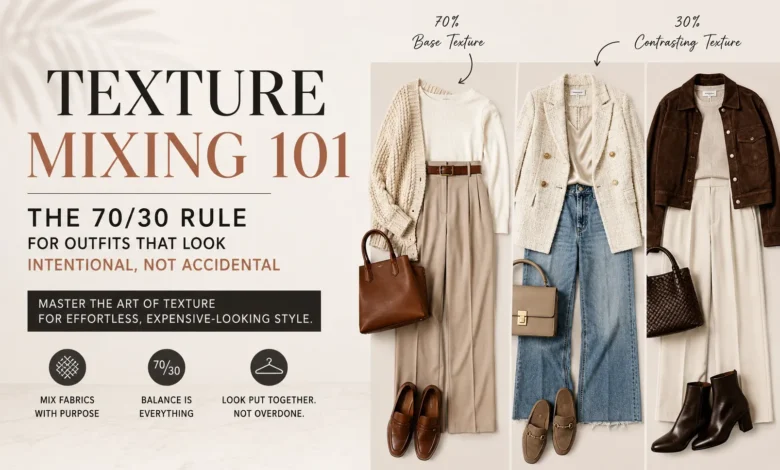
The 70/30 rule is simple: 70% of your outfit should be in one texture family, 30% in a contrasting one. This ratio creates enough contrast to read as intentional without tipping into visual overload.
In practice it looks like this:
- 70% smooth/matte + 30% textured: tailored wool trousers and a fitted cotton tee (70% smooth) with a chunky knit cardigan thrown over the top (30% textured). The knit is the texture moment; everything underneath it is the calm base.
- 70% textured + 30% smooth: a bouclé blazer and knit skirt (70% textured) with a silk or satin cami underneath and smooth leather loafers (30% smooth). The smooth elements stop the outfit from reading as too heavy.
- 70% matte + 30% sheen: wide-leg linen trousers and a matte cotton tee (70% matte) with a leather belt and glazed leather mules (30% sheen). The sheen comes from accessories, not garments — this is the easiest application of the rule.
The rule breaks when: you introduce a third distinct texture family without increasing the overall outfit count. Three textures across three garments (bouclé blazer + silk blouse + velvet trouser) is too much contrast in too small a space. Three textures across five pieces works because the ratio naturally distributes. When in doubt, add the third texture via accessories — a bag, a shoe, a belt — rather than another garment.
The Texture Families: A Practical Reference
Before applying the 70/30 rule, you need to know which fabrics belong to which texture family. Most guides list random fabric names without organising them — which is why readers finish the article and still can’t apply the advice. Here’s the working framework:
Family 1: Smooth and Light-Reflective
Fabrics that reflect light and read as sleek, refined, or formal:
- Silk and silk-look fabrics (charmeuse, satin-back crepe)
- Satin
- Glazed or polished leather
- Faux leather with a high finish
- Velvet (technically has pile, but reflects light directionally — behaves more like a smooth fabric in outfits)
- Lacquered or coated cotton
Best paired against: matte, rough-surface, or heavily textured fabrics. The contrast between smooth/reflective and matte/absorbing is the most versatile texture combination in everyday dressing.
Family 2: Matte and Structured
Fabrics that absorb light and read as clean, minimal, or tailored:
- Tailored wool and wool blends
- Cotton (woven, not knit)
- Linen
- Denim
- Gabardine and ponte
Best paired against: either light-reflective fabrics (Family 1) for a refined contrast, or rough/organic fabrics (Family 3) for a casual-intentional contrast. Matte structured fabrics are the most neutral texture base — they work against almost everything.
Family 3: Rough, Organic, and Tactile
Fabrics with visible surface interest, irregularity, or grip:
- Bouclé
- Tweed
- Raw or slubbed linen
- Chunky knit and cable knit
- Corduroy
- Shearling
- Washed or distressed denim (different texture family from clean denim)
Best paired against: smooth structured fabrics (Family 2) or light-reflective fabrics (Family 1). Two rough/organic fabrics together (bouclé blazer + cable knit trousers) compete rather than contrast — both are visually heavy and the outfit reads as dense rather than layered.
Family 4: Soft and Drapey
Fabrics that fall and move rather than hold structure:
- Jersey and modal knits
- Cashmere and fine knit
- Chiffon
- Crepe (unbacked)
- Viscose and rayon
Best paired against: structured fabrics (Family 2) or rough fabrics (Family 3). A soft drapey top with tailored structured trousers is one of the most reliable combinations in everyday dressing. A soft drapey top with soft drapey trousers reads as shapeless rather than relaxed unless the silhouette itself provides structure through cut.
Also Read: Capsule Wardrobe Essentials 2026: What to Keep, What to Buy, and What to Skip
The 6 Texture Combinations That Always Work
These are the pairings that work reliably across seasons, budgets, and body types. Each one is built on the 70/30 principle and involves fabrics from two different texture families.
1. Suede + Smooth Knit
A suede shoe or suede jacket (rough/organic, Family 3) against a smooth fine knit or fitted jersey top (soft/drapey, Family 4). This is the easiest texture combination for beginners because suede is forgiving — it adds visual interest without being as heavy as bouclé or tweed.
Specific example: suede loafers + fitted merino knit + tailored trousers. Three pieces, two texture families, clear 70/30 split.
2. Leather + Soft Knit
Leather (smooth/reflective, Family 1) against a chunky or cable knit (rough/organic, Family 3). The contrast between the structured, reflective quality of leather and the soft, irregular surface of a knit is one of the strongest texture pairings in fashion. Works in both directions: leather jacket over a knit, or leather trousers with a soft knit top.
Specific example: leather trim jacket + cream cable knit underneath + straight-leg denim. The leather trim provides the 30% contrast; the knit and denim are both in the matte/textured family.
3. Linen + Satin or Silk
Raw or slubbed linen (rough/organic, Family 3) against silk or satin (smooth/reflective, Family 1). This is a summer-specific combination that reads as expensive because both fabrics are associated with quality, but their surface qualities are direct opposites. A satin cami under an open linen blazer is one of the highest-impact low-effort combinations in warm-weather dressing.
Specific example: linen wide-leg trousers + satin cami + leather sandal. The satin and leather are both Family 1; the linen is the 70% base.
4. Bouclé + Smooth Tailoring
Bouclé (rough/organic, Family 3) against smooth structured wool or gabardine (matte/structured, Family 2). This is a cooler-weather combination that forms the backbone of the 2026 texture trend. The irregular looped surface of bouclé against clean tailored trousers creates a combination that reads as intentionally designed rather than accidentally assembled.
Specific example: bouclé blazer + smooth tailored trousers + leather loafer. The bouclé is the entire 30% — one textured piece, everything else smooth and structured.
5. Denim + Velvet or Satin
Clean denim (matte/structured, Family 2) against velvet or satin (smooth/reflective, Family 1). This combination works because denim is culturally casual and velvet or satin is culturally formal — the texture contrast is reinforced by a formality contrast, which makes the outfit read as deliberately mixed rather than accidentally mismatched.
Specific example: dark wash straight-leg jeans + velvet blazer + white fitted tee underneath. The velvet provides the texture and formality contrast; the white tee and denim are the clean base.
6. Chunky Knit + Sleek Leather or Faux Leather
A chunky knit (rough/organic, Family 3) with leather or faux leather trousers or a leather skirt (smooth/reflective, Family 1). This is the autumn/winter version of the linen-satin combination — two fabrics with completely opposite surface qualities, both reading as high quality in their respective categories.
Specific example: oversized chunky knit + straight leather-look trouser + ankle boot. The leather trouser is the 30% contrast element; the knit provides the 70% textured base.
The 3 Texture Combinations That Never Work
1. Two Rough/Organic Fabrics as Main Garments
Bouclé blazer + tweed trousers, or cable knit top + corduroy trousers. Both fabrics are from Family 3 and have similar light-absorbing, visually heavy surface qualities. The outfit reads as dense and flat — there’s no contrast for the eye to move between. Fix: keep one rough/organic piece and pair it with something from Family 1 or Family 2.
2. Two Light-Reflective Fabrics Head-to-Toe
Satin blouse + velvet trousers, or silk top + glazed leather skirt. Both fabrics reflect light, but they do so differently — and when two reflective surfaces compete in the same outfit, the result reads as overdressed or costume-adjacent rather than polished. Fix: use one reflective piece as the 30% element against a matte base.
3. Three Different Textures Across Three Garments
Linen blazer + silk blouse + velvet trouser — three different texture families in three adjacent garments. Each transition is a visual interruption, and the eye doesn’t know where to settle. Fix: consolidate two of the three garments into the same texture family, or move the third texture to an accessory.
PRO TIP — The Texture Check Before You Leave
Before finalising any outfit, identify which texture family each garment belongs to. If every garment is in the same family, add one contrasting piece — even just a leather belt or suede shoe. If you have three different texture families across three garments, remove or swap one. This check takes 20 seconds and catches most texture-mixing problems before they leave the house.
Texture Mixing by Season: What Changes and What Doesn’t
The 70/30 rule applies year-round. What changes seasonally is which fabrics are available and appropriate for the temperature.
Spring/Summer texture combinations:
- Linen (rough/organic) + satin or silk (reflective) — the strongest warm-weather pairing
- Cotton poplin (matte/structured) + fine jersey (soft/drapey)
- Lightweight knit (soft/drapey) + woven cotton or linen trouser (matte/structured)
- Avoid: heavy bouclé, velvet, shearling, thick leather — all carry too much visual and thermal weight for warm months
Autumn/Winter texture combinations:
- Bouclé or tweed (rough/organic) + smooth tailored wool (matte/structured)
- Chunky knit (rough/organic) + leather or suede (reflective or rough/organic respectively — suede is transitional)
- Velvet (reflective) + matte structured base (denim, gabardine, tailored wool)
- Cashmere or fine knit (soft/drapey) + structured outerwear in leather or wool
One thing competitors consistently miss: texture mixing changes at the accessory level between seasons even when the garment-level combinations stay consistent. A matte linen trouser + smooth knit combination works in both spring and autumn — but in spring the accessory texture might be a woven raffia bag, and in autumn it shifts to a suede tote. The garment-level rule stays the same; the seasonal texture update comes from accessories.
Texture Mixing on a Budget: What to Prioritise
The most accessible texture upgrade in any wardrobe doesn’t come from buying new garments — it comes from footwear and bags. A suede loafer costs less than a bouclé blazer and creates the same quality of texture contrast when paired against smooth or matte clothing. Budget priorities in order:
Budget tier ($20–$80)
- One pair of suede or suede-look shoes ($30–$70): the single highest-impact texture addition at the lowest price point — suede against smooth denim or tailored trousers immediately reads as intentional
- A woven or textured bag ($20–$50): raffia, woven cotton, or structured faux leather in a contrasting surface to your most-worn outfits
- A knit scarf or wrap in a chunky or bouclé yarn ($15–$35): adds Family 3 texture to any outfit without requiring a new garment
Investment tier ($100–$300)
- A bouclé or textured blazer ($100–$200 on sale or second-hand): the most versatile single texture investment because it adds instant contrast to tailored trousers, denim, smooth skirts, and jersey dresses equally
- Quality leather or suede accessories — a belt ($40–$80) or structured bag ($100–$200): leather accessories in regular rotation have some of the lowest cost-per-wear of any wardrobe item
- A fine merino or cashmere knit ($80–$150): Family 4 soft/drapey — pairs cleanly against structured trousers, leather, and denim, and works across 8–9 months of the year
Common Texture Mixing Mistakes
Using texture only in statement pieces and not in basics. Most people save textured pieces for special occasions and default to single-texture basics on everyday outfits. The 70/30 rule works precisely because one texture element — even just suede shoes against smooth trousers — is enough. Texture mixing doesn’t require a statement piece; it requires one contrasting surface anywhere in the outfit.
Confusing pattern mixing with texture mixing. A floral print and a plaid are two patterns — mixing them is pattern mixing, which follows entirely different rules. Texture mixing is about surface quality (smooth vs. rough, matte vs. reflective), not visual design. You can mix textures without mixing patterns, and you can mix patterns while staying in a single texture family. Treating them as the same thing leads to outfits that are doing too much in both dimensions simultaneously.
Adding texture contrast only through colour. A red velvet top against black denim is a color contrast and a texture contrast — but if you remove the color difference, is the texture contrast still there? If the answer is no, the outfit is relying on color to do the work texture should be doing. Build texture contrast first, then layer color. If the texture combination works in two neutrals, the color is genuinely additive rather than compensatory.
Buying textured pieces without checking what they pair with. A bouclé blazer is a significant investment that only earns its place if it pairs with at least 5 existing pieces in your wardrobe. Before buying any textured piece, identify which texture family it belongs to and count how many of your existing garments are in a contrasting family. If the answer is fewer than 3, the piece has limited outfit versatility in your current wardrobe.
Also Read: How to Build a Capsule Wardrobe in 2026: The Step-by-Step Guide for Every Budget
Conclusion
Texture mixing is not an advanced styling technique — it’s a formula. The 70/30 rule, applied consistently, turns flat single-fabric outfits into ones that hold visual interest across a full day. Identify your texture families, pick one contrasting pairing, keep the ratio at 70/30, and use accessories to introduce the third texture when needed. That’s the whole system.
Start with one suede shoe or one textured bag against your most-worn neutral outfit. The difference is immediate and costs nothing if you already own the pieces.
Frequently Asked Questions
Texture mixing is the deliberate pairing of fabrics with different surface qualities — smooth vs. rough, matte vs. reflective, structured vs. drapey — in a single outfit to create visual contrast and depth. It’s distinct from pattern mixing, which is about visual design rather than surface quality. An all-grey outfit with a bouclé blazer over tailored wool trousers is texture mixing; an all-grey outfit with a floral print and a plaid is pattern mixing.
The 70/30 rule for texture mixing states that 70% of an outfit should be in one texture family and 30% in a contrasting one. This ratio creates enough visual contrast to read as intentional without introducing too many competing surfaces. In practice: one textured piece (a bouclé blazer, a suede shoe, a chunky knit) against a smooth or matte base is usually enough to apply the rule correctly.
Two rough or heavily textured fabrics worn as main garments — bouclé with tweed, or cable knit with corduroy — compete rather than contrast, reading as visually dense rather than layered. Two light-reflective fabrics (satin with velvet, silk with glazed leather) create a similar problem in the opposite direction. The reliable rule: pair one fabric from a rough or organic family with one from a smooth or matte family, not two from the same family.
Start at the accessory level, not the garment level. A suede shoe or a woven bag against a plain smooth-fabric outfit is texture mixing in its simplest form — and it costs nothing if you already own either piece. Once you’ve confirmed that one texture contrast reads well in your outfits, add a textured garment: a bouclé blazer, a chunky knit, or a linen jacket are the most versatile entry points.
The 70/30 rule and the four texture families apply identically regardless of gender. The specific garment combinations differ: men’s texture mixing most commonly appears as a knit or flannel shirt under a structured jacket, suede or textured leather shoes against smooth tailored trousers, or a chunky knit over smooth denim. Women’s combinations tend to include a wider range of garment types (skirts, dresses, blazers in textured fabrics) but the underlying contrast principle is the same.
Also Read: Fashion Trends 2026: The Complete Guide to What’s In, What’s Out, and How to Actually Wear Them