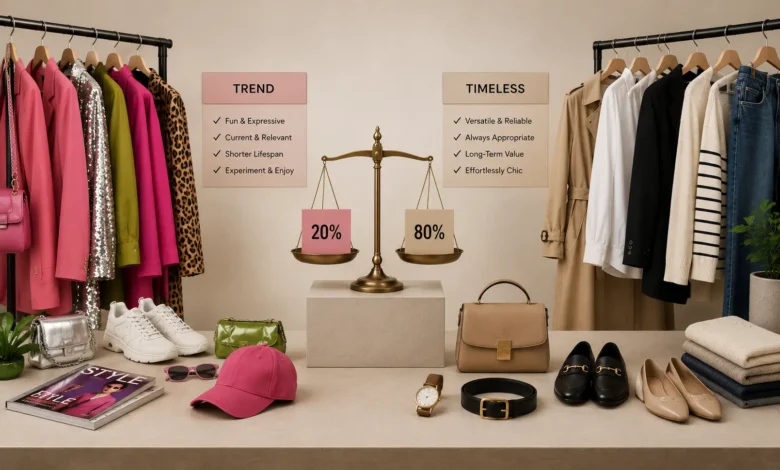
One of the most common style dilemmas isn’t about which color or silhouette to wear — it’s about which philosophy to follow. Should you chase the latest trend before it disappears, or invest in classic pieces that never go out of style? The truth is, neither extreme works well on its own. A wardrobe built entirely around trends becomes expensive and short-lived. A wardrobe built entirely around timeless basics can feel flat, repetitive, or disconnected from your actual personality.
The real answer isn’t choosing one side — it’s finding the right balance between the two, based on your budget, your lifestyle, and how much you genuinely enjoy experimenting with fashion. This guide breaks down exactly how to strike that balance so your wardrobe feels current without constantly needing to be replaced.
It’s also worth recognizing that this balance isn’t fixed forever. Your relationship with trends and timelessness will naturally shift depending on your season of life, your budget, and even your mood. Someone building a wardrobe on a tight budget after a big life change may lean heavily timeless out of necessity, while someone with more disposable income and a genuine passion for fashion might comfortably enjoy a much higher ratio of trend pieces. There’s no universally “correct” balance — only the one that fits your actual circumstances.
What “Trend-Driven” and “Timeless” Actually Mean
Before deciding how to balance the two, it helps to define them clearly, since both terms get used loosely.
Trend-driven style follows what’s currently popular in fashion — a specific silhouette, color, print, or styling technique that’s widely visible for a defined period, often driven by runway shows, celebrity style, or social media. Trends tend to have a relatively short shelf life; some last a single season, while others stretch into a year or two before fading.
Timeless style refers to pieces and silhouettes that remain wearable and relevant across years, sometimes decades, without feeling dated. A well-tailored blazer, a classic trench coat, a simple white shirt, or straight-leg jeans are common examples — items that have appeared in wardrobes consistently for generations because they flatter a wide range of bodies and pair easily with almost anything.
Neither approach is inherently “better.” Trend-driven style offers creativity, self-expression, and the excitement of trying something new. Timeless style offers reliability, cost efficiency, and long-term versatility. The goal isn’t to pick a side permanently — it’s to understand what each one offers so you can decide, piece by piece, which approach makes sense.
It’s also worth noting that these two categories aren’t always as separate as they seem. Many pieces considered timeless today — the trench coat, the little black dress, straight-leg denim — were once trends themselves that simply proved durable enough, both physically and stylistically, to outlast their original moment. Understanding this helps explain why some trends are worth genuine investment while others are better treated as short-term experiments: the difference often comes down to whether a trend reflects a lasting shift in how people want to dress, or a fleeting novelty driven mostly by visibility and marketing.
Also Read: How to Build a Wardrobe That Matches Your Daily Routine
The Real Cost of Chasing Every Trend
Following every emerging trend comes with costs that go beyond the price tag of each individual item.
Financial cost. Trend cycles have accelerated significantly in recent years, with some “micro-trends” lasting only a few weeks online before fading. Continuously buying into these means spending regularly on pieces with a very short usable lifespan.
Wardrobe cohesion. Trend pieces are often designed to stand out, which can make them harder to combine with each other. A closet built primarily from standalone trend pieces frequently ends up looking disjointed rather than cohesive, since each item was designed to be a statement on its own rather than part of a broader system.
Storage and clutter. Trend items that fall out of favor rarely get worn again, even if they’re still in good condition. Over time, this creates closets full of barely-worn pieces that quietly take up space without adding daily value.
Environmental impact. Fast fashion, which fuels much of trend-chasing behavior, is associated with significant textile waste and a shorter garment lifecycle overall. A wardrobe leaning heavily on rapidly cycling trends tends to produce far more discarded clothing over time than one built around durable, versatile pieces.
None of this means trends should be avoided entirely — it simply means chasing every trend, particularly through low-cost, low-durability pieces, tends to be an expensive and cluttering habit rather than a genuinely stylish one.
The Hidden Risk of Going Fully Timeless
On the other end of the spectrum, an all-timeless wardrobe has its own risks, even though they’re less commonly discussed.
Feeling stylistically flat. Neutral, classic pieces are versatile by design, but relying on them exclusively can leave a wardrobe feeling safe to the point of being forgettable, without much personality or visual interest.
Missing genuine self-expression. Trends, prints, and bold color choices are often how people communicate personality and current taste through clothing. Avoiding them entirely in favor of pure timelessness can mean losing an outlet for creativity that many people genuinely enjoy.
Looking dated in a different way. Ironically, an entirely unchanging wardrobe can eventually start to look dated too — not because any single piece falls out of style, but because the overall look never evolves alongside subtle shifts in fit, proportion, or styling that happen even within classic categories over time.
Underestimating “timeless” as a moving target. What’s considered a timeless silhouette does shift gradually — jean cuts, blazer proportions, and shoe shapes all evolve slowly over decades. A wardrobe that hasn’t been refreshed in years, even with “classic” pieces, can start to feel subtly out of step.
This is exactly why the goal isn’t pure timelessness either. A wardrobe with zero trend influence often ages in its own quiet way, just more slowly than a trend-heavy one.
The 80/20 Approach to Balancing Both
A widely used and practical framework for balancing trend and timeless style is what’s often called the 80/20 approach: roughly 80% of your wardrobe built from timeless, versatile staples, with the remaining 20% left open for trend pieces, bold experimentation, or seasonal refreshes.
This ratio works well for a few reasons. The larger timeless base ensures your everyday outfits remain functional, versatile, and cost-effective over the long run — you’re not relying on fast-changing pieces to get dressed most days. The smaller trend allocation keeps your wardrobe feeling current and gives you room for creative self-expression, without the financial or clutter costs of trend-chasing at scale.
In practice, this might look like:
- A base wardrobe of well-fitting trousers, jeans, blazers, simple tops, and neutral outerwear
- A smaller, rotating selection of trend-driven accessories, one or two seasonal statement pieces, or a current color or print incorporated through lower-cost items
The exact ratio can flex based on your personal interest in fashion. Someone who genuinely enjoys experimenting with trends might comfortably shift toward a 70/30 or even 60/40 split, while someone who prioritizes simplicity and cost efficiency might lean closer to 90/10. The framework is a starting point, not a rigid rule.
To see how this plays out practically, imagine two people shopping for the same season. The first, following an 80/20 approach, spends most of their budget completing gaps in their timeless base — a better-fitting pair of trousers, a versatile blazer — and sets aside a smaller amount for one or two current trend pieces, like a seasonal color or an accessory. The second, shopping without any framework, might spend the same total budget entirely on trend pieces, ending up with several items that only work with each other and little foundation to build future outfits around. Both spent the same amount, but the first ends up with a far more functional, longer-lasting wardrobe.
How to Tell If a Trend Is Worth Investing In
Not every trend deserves the same level of investment. A simple set of questions can help filter which trends are worth spending on versus which are better left as a passing interest.
Does it suit your existing style? A trend that aligns naturally with pieces you already own and love is far more likely to get worn repeatedly than one that requires building an entirely new aesthetic around it.
Can you picture wearing it multiple ways? If a trend piece only works with one very specific outfit, it’s a much riskier purchase than one that can be styled several different ways with items already in your closet.
Has it shown staying power? Trends that persist for multiple seasons, gradually shifting rather than disappearing, are generally safer investments than micro-trends that peak and fade within weeks.
Is it available at a low-risk price point? For trends you’re uncertain about, it often makes sense to test them through affordable pieces or accessories first, reserving higher spending for trends that have proven, through personal experience, that you’ll actually wear them.
Does it flatter your body and coloring? A trend that doesn’t suit your proportions or coloring is unlikely to become a regular part of your rotation, regardless of how popular it currently is.
Running a potential purchase through these questions takes only a moment but meaningfully reduces the number of trend pieces that end up unworn after the first few wears.
Also Read: Fashion Trends 2026: The Complete Guide to What’s In, What’s Out, and How to Actually Wear Them
Building Your Timeless Foundation First
Because the timeless portion of a balanced wardrobe carries the most daily weight, it’s worth prioritizing this foundation before adding trend pieces on top of it. A strong foundation typically includes:
| Category | Example Staples |
|---|---|
| Tops | White button-down shirt, simple crewneck or v-neck tops, a classic knit sweater |
| Bottoms | Well-fitting straight or slim jeans, tailored trousers, a versatile midi skirt |
| Outerwear | A tailored blazer, a classic trench coat or wool coat |
| Dresses | A simple wrap or sheath dress in a neutral color |
| Shoes | Neutral sneakers, classic loafers or flats, a versatile heel or boot |
| Accessories | A quality leather bag, simple jewelry, a classic watch |
These categories don’t need to be filled all at once, and they don’t need to be expensive from day one. The goal is simply to prioritize these versatile, long-lasting categories first, so that whatever trend pieces you add later have a strong, functional base to pair with — rather than becoming the only interesting pieces in an otherwise disconnected closet.
Where to Spend on Trends (and Where to Save)
A practical rule for managing trend spending is to match the investment level to the item’s expected lifespan and versatility.
Spend more on trends when:
- The trend has shown consistent staying power across multiple seasons
- The piece is genuinely versatile and can be styled multiple ways
- It’s a category you’ll wear frequently, like a jacket or a pair of shoes
Save on trends when:
- The trend is highly specific, bold, or likely to feel dated quickly
- It’s your first time testing whether a trend suits you
- The item is a smaller accessory — jewelry, a scarf, a bag charm — where lower-cost versions look nearly identical to expensive ones
This approach naturally protects your budget from the riskiest trend purchases while still allowing genuine experimentation. Reserving your more significant spending for either timeless staples or trends with proven staying power tends to produce a far more cost-effective wardrobe over time than spreading spending evenly across everything that catches your eye.
Signs Your Style Balance Needs Adjusting
A few signals suggest your current mix of trend and timeless pieces may need rebalancing:
- Your closet feels visually chaotic, with pieces that don’t combine well into full outfits
- You regularly buy trend pieces that go unworn after one or two outings
- Your wardrobe feels overly plain or repetitive, without much personality or excitement
- You feel behind on trends despite spending regularly on new clothes
- Getting dressed takes longer than it should, because pieces don’t naturally pair together
If your closet leans too heavily trend-driven, the fix is usually to pause new trend purchases and invest instead in a few missing timeless staples that can anchor your existing pieces. If it leans too far toward timeless and feels flat, the fix is often smaller — adding a few accessories, a bold color, or one current silhouette to refresh the overall look without a major wardrobe overhaul.
Frequently Asked Questions
Is it better to follow trends or stick to timeless pieces?
Neither extreme tends to work well long-term. A blended approach — a timeless foundation with a smaller portion of trend pieces — typically offers the best combination of cost efficiency, versatility, and personal style expression.
How do I know if a trend will last or fade quickly?
Trends that echo silhouettes or details from previous decades, or that have already persisted across two or more seasons, tend to have more staying power than entirely new, highly specific micro-trends.
Should I ever spend a lot of money on a trend piece?
Only if the trend has shown consistent staying power and the piece is genuinely versatile enough to style multiple ways. For untested or highly specific trends, it’s generally safer to start with a lower-cost version first.
How often should I refresh the trend portion of my wardrobe?
There’s no fixed rule, but reviewing it once or twice a year — alongside a broader wardrobe audit — is usually enough to keep things feeling current without constant, unnecessary spending.
Can a wardrobe be too timeless?
Yes. While rare compared to trend-heavy wardrobes, an entirely classic wardrobe with no trend influence at all can start to feel flat or impersonal over time. A small amount of trend-driven experimentation helps keep a wardrobe feeling like an authentic reflection of current taste.
What’s the easiest way to start balancing trend and timeless pieces?
Start by identifying and filling any gaps in your timeless foundation first. Once that base is solid, add trend pieces gradually, testing lower-cost versions before investing more heavily in ones that prove to genuinely fit your style.
Finding the right balance between trend and timeless style isn’t about following a strict formula — it’s about understanding what each approach offers and adjusting the mix to fit your budget, lifestyle, and personal taste. Start with a solid timeless foundation, then layer in trends selectively, and your wardrobe will stay both current and genuinely functional for years to come. Revisit the balance periodically as your life and style evolve, and let it shift naturally rather than forcing it to stay fixed.
Also Read: Fashion Lifestyle: How Your Style Choices Shape Your Everyday Life