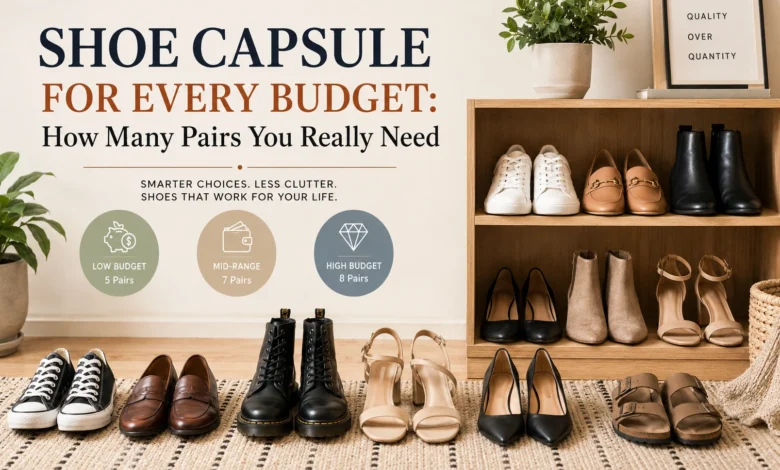
Shoes are usually the last thing people think about when building a wardrobe, and the first thing that quietly gets out of control. A single impulse buy here, a “for one event” pair there, and within a couple of years the closet floor is covered in shoes that rarely get worn — while the same three or four pairs handle almost every outfit.
The good news is that a well-planned shoe capsule doesn’t require a big budget. It requires a clear list of roles that shoes need to fill, and a willingness to buy fewer pairs that actually cover those roles well. This guide breaks down exactly how many pairs are genuinely needed, what those pairs should be, and how the entire capsule can be built at three different budget levels — low, mid, and high — without sacrificing versatility at any of them.
What Is a Shoe Capsule Wardrobe?
A shoe capsule wardrobe is a small, intentional collection of footwear — typically somewhere between five and eight pairs — where every single pair has a distinct, non-overlapping job. Instead of buying shoes reactively (a cute pair spotted in-store, a trend seen online, an event-specific purchase that never gets repeated), a shoe capsule works backward from real life: the commute, the job dress code, the weekend routine, the handful of dressier occasions that come up throughout the year.
This is the same logic behind a capsule wardrobe or a denim capsule, applied specifically to footwear — a category that tends to accumulate unnoticed because individual pairs are often bought for a single moment rather than long-term use.
Why Shoes Deserve Their Own Capsule Thinking
Footwear has a few characteristics that make it worth treating separately from the rest of the closet:
Cost varies enormously for the same function. A pair of white sneakers can cost $30 or $300 and serve nearly the same visual purpose in an outfit. This makes shoes one of the easiest categories to either overspend or underspend in, without much thought given to which pairs are actually worth the higher investment.
Wear patterns are highly uneven. Most people wear two or three pairs of shoes on rotation for 80% of their life, while the rest sit largely untouched. A shoe capsule makes this uneven usage intentional instead of accidental — the “everyday” pair gets picked deliberately, rather than by default.
Shoes are occasion-specific in a way clothing often isn’t. A top or dress can often be restyled across several contexts, but shoes are frequently tied to a very specific use case — a hiking trip, a wedding, a job interview — which makes it tempting to keep buying single-purpose pairs instead of investing in versatile ones.
Also Read: Texture Mixing 101: The 70/30 Rule for Outfits That Look Intentional, Not Accidental
How Many Shoes Do You Actually Need?
For most lifestyles, five to eight pairs covers everything from daily commuting to formal events, across all four seasons. The exact number depends less on personal taste and more on lifestyle factors: climate, job dress code, and how often dressier occasions actually come up.
The Minimalist Shoe Capsule (5 Pairs)
Best for people who want the smallest possible footwear collection while still covering every major need.
- Everyday sneakers — for commuting, errands, and casual weekend wear
- Classic flats or loafers — a polished option that works for the office or smart-casual outings
- One versatile boot (ankle boot or chelsea boot) — bridges casual and slightly dressier looks, and works across cooler months
- A dressy heel or dress shoe — for weddings, dinners, and formal occasions
- Weather-specific footwear — a rain boot, snow boot, or sandal depending on local climate
The Balanced Shoe Capsule (7–8 Pairs)
Better suited to people who want more range across seasons, dress codes, and social occasions.
- Everyday white or neutral sneakers
- Classic flats or loafers
- Ankle boots
- Knee-high or tall boots (useful in colder climates)
- Block-heel or comfortable mid-height heels
- Dressy heels or formal shoes for special events
- Sandals or open shoes for warmer months
- One statement pair — a bold color, print, or silhouette that reflects personal style
When Fewer or More Pairs Makes Sense
Someone with a very casual lifestyle — remote work, minimal social events, a mild climate — may comfortably manage with just three or four pairs. On the other end, people whose jobs demand specific formal footwear, or who live somewhere with genuinely extreme seasonal shifts, may reasonably need nine or ten pairs. The core principle stays the same regardless of the final number: every pair should have a job that no other pair in the closet already covers.
The Five Roles Every Shoe Capsule Should Fill
Regardless of exact pair count or budget level, these five roles form the foundation of a functional shoe capsule.
1. The Everyday Sneaker
This is the most-worn pair in almost every capsule. A clean, neutral sneaker — white, black, or a simple two-tone — pairs with jeans, casual dresses, and athleisure alike. It should be comfortable enough for all-day wear and neutral enough to disappear into most outfits rather than compete with them.
2. The Polished Flat or Loafer
This pair bridges the gap between sneakers and heels. It reads as put-together without being formal, making it ideal for office environments, smart-casual dinners, or any setting where sneakers feel slightly too relaxed but heels feel like overkill.
3. The Versatile Boot
A boot — ankle-height for warmer climates, taller for colder ones — extends the capsule’s range into cooler months and adds a slightly edgier or more elevated feel to casual outfits. This is often the single most cost-effective pair in the entire capsule, since a well-made boot can be worn almost daily throughout an entire season.
4. The Dress Shoe or Heel
Reserved for weddings, formal dinners, job interviews, and other occasions that call for something more elevated. This pair is typically worn least often, which means it’s usually safe to prioritize style and comfort here over heavy-duty durability.
5. Weather- or Season-Specific Footwear
Depending on climate, this could be sandals for hot summers, insulated boots for snow, or rain-appropriate shoes for wetter regions. This category is the most personal of the five, since it depends entirely on where someone lives and how the seasons actually behave there.
Building the Capsule on a Low Budget
A functional five-pair shoe capsule can absolutely be built without a large financial investment. The key at this budget level is prioritizing comfort and basic construction quality over brand names or trend-driven details.
Everyday sneakers: Budget-friendly canvas or basic athletic sneakers in white or black cover this role well. Focus on a comfortable insole and a simple, non-flashy design that won’t look dated quickly.
Flats or loafers: Affordable faux-leather options can look nearly identical to pricier leather versions from a short distance, especially in classic black or nude tones.
Boots: A basic ankle boot in a synthetic material can perform well for a season or two, particularly if it isn’t worn in heavy rain or snow, which tends to wear down cheaper materials faster.
Dress shoe: A simple block-heel pair in black is versatile enough to cover most formal needs and tends to be more affordable than pointed-toe or stiletto styles.
Weather-specific: Budget rain boots or basic flip-flop-style sandals fulfill this role at minimal cost, especially since this pair typically sees lighter, more occasional use.
At this budget level, the main trade-off is longevity — expect to replace pairs somewhat more often — but the capsule structure still delivers strong day-to-day versatility.
Building the Capsule on a Mid-Range Budget
A mid-range budget allows for slightly better materials and construction, which usually translates into a noticeably longer lifespan per pair.
Everyday sneakers: Mid-tier athletic or lifestyle brands typically offer better cushioning and more durable soles, which matters most for the pair worn nearly every day.
Flats or loafers: Genuine leather uppers, even from less premium brands, tend to mold to the foot over time and hold their shape better than synthetic alternatives.
Boots: A leather ankle boot at this price point can often be resoled once the original sole wears down, extending its life significantly beyond the initial purchase.
Dress shoe: A well-constructed heel with a comfortable heel height (often block or kitten heels rather than very high stilettos) balances formality with actual wearability across a full evening.
Weather-specific: Slightly higher-quality sandals or weatherproof boots at this level tend to hold up across multiple seasons rather than needing annual replacement.
This budget tier often represents the best overall value, since the jump in durability and comfort from low to mid-range tends to be larger than the jump from mid-range to high-end.
Building the Capsule on a High Budget
At a higher budget, the focus shifts from “will this last a reasonable amount of time” to “will this last for many years and improve with age” — a shift that matters most for the pairs worn most frequently.
Everyday sneakers: Premium leather or well-constructed canvas sneakers from established brands often hold their shape and cushioning far longer, which matters given how frequently this pair gets worn.
Flats or loafers: High-quality leather loafers, particularly from brands known for classic construction, can last a decade or more with occasional resoling and proper care.
Boots: Full-grain leather boots represent one of the best long-term investments in a shoe capsule, since quality leather actually improves in appearance as it breaks in, unlike most other materials.
Dress shoe: A well-made heel in high-quality leather or suede tends to hold its structure and comfort far better across repeated wears at events spaced months apart.
Weather-specific: Premium all-weather boots or well-constructed sandals at this tier are often built to handle years of seasonal rotation without significant wear.
It’s worth noting that a high budget doesn’t need to be spent evenly across all five categories. Many people choose to invest heavily in the one or two pairs worn most often — typically the everyday sneaker and the versatile boot — while keeping the dress shoe and weather-specific pairs at a more moderate price point, since those see far less use.
How to Audit the Shoes You Already Own
Before building or expanding a shoe capsule, it helps to sort through the shoes already in the closet using the same three-pile method that works well for clothing audits.
- Keep — worn within the last few months, still comfortable, no significant visible damage
- Repair — good potential but needs a sole replacement, cleaning, or minor fix to become wearable again
- Release — untouched for over a year, no longer comfortable, or duplicates another pair in the closet almost exactly
A useful step during this process is trying on pairs that haven’t been worn recently, since fit and comfort in shoes can shift over time even without any visible damage. It’s also worth checking whether multiple pairs are quietly filling the exact same role — two nearly identical pairs of white sneakers, for example — since one of them is likely a candidate to donate or replace with something that fills a genuine gap instead.
Also Read: How to Wear Color Without Overdoing It: The One-Punch Rule for Confident Dressing
Cost-Per-Wear: The Real Way to Judge Shoe Value
As with denim, the smartest way to evaluate whether a shoe purchase was worth it isn’t the price tag alone — it’s the price divided by how many times the shoe actually gets worn.
| Shoe Role | Typical Wear Frequency | Where to Prioritize Budget |
|---|---|---|
| Everyday sneakers | Several times a week | High priority |
| Flats or loafers | Weekly | Medium-high priority |
| Versatile boots | Weekly (in-season) | High priority |
| Dress shoes/heels | A few times a year | Lower priority |
| Weather-specific | Seasonal | Medium priority |
This table makes clear why spending more on the everyday sneaker or the versatile boot tends to make more financial sense than spending heavily on the dress shoe, which sees far less regular use regardless of budget level.
Caring for a Shoe Capsule
A smaller shoe collection means each pair needs to last longer, which makes basic care habits more important than they might be in a larger, more disposable footwear collection.
- Rotate pairs rather than wearing the same shoes on consecutive days, which allows the material and cushioning to recover between wears
- Use shoe trees or stuffing for leather shoes and boots to help them hold their shape while not in use
- Clean and condition leather periodically rather than waiting until visible damage appears
- Resole rather than replace when the upper is still in good shape but the sole has worn down — often significantly cheaper than buying a new pair entirely
- Store away from direct sunlight and heat, which can dry out and crack leather over time
Common Shoe Capsule Mistakes to Avoid
Buying for a single event rather than a role. A pair purchased specifically for one wedding or one party often ends up being worn exactly once, which makes it one of the least cost-effective purchases in the entire wardrobe.
Overinvesting in the least-worn category. Spending the bulk of a shoe budget on formal shoes worn only a handful of times a year, while wearing worn-out sneakers daily, tends to work against the actual goal of a functional capsule.
Skipping the audit step. Many people already own several pairs that could form the foundation of a solid capsule — the issue is usually duplication and neglect, not an actual lack of options.
Ignoring climate realities. A shoe capsule built around a different climate than the one someone actually lives in — too many open sandals in a cold, wet region, for example — quickly reveals its gaps once the season changes.
Frequently Asked Questions
How many pairs of shoes does a person actually need?
Most people can cover every realistic need with five to eight pairs: an everyday sneaker, a polished flat or loafer, a versatile boot, a dress shoe, and one weather-specific pair suited to their local climate.
Can a good shoe capsule really be built on a low budget?
Yes. A functional five-pair capsule is achievable at a low budget by prioritizing comfort and basic construction quality over brand names, though pairs may need replacing somewhat more frequently than higher-priced alternatives.
Which shoe is worth spending the most money on?
The everyday sneaker and the versatile boot typically see the most use, which makes them the strongest candidates for a higher budget allocation compared to shoes worn only occasionally, like formal heels.
How often should shoes be replaced?
Everyday shoes like sneakers or loafers often need replacing every one to two years with regular wear, while well-made boots and dress shoes, especially in leather, can last five years or more with proper care and occasional resoling.
Is it worth resoling shoes instead of buying new ones?
Often, yes — particularly for leather boots and dress shoes with a sturdy upper. Resoling is typically far cheaper than a full replacement and can extend a good pair’s life by several additional years.
How do I know if I have too many shoes?
A simple test is checking how many pairs haven’t been worn in the past year. If several pairs fall into that category, or if multiple pairs are serving the exact same function, the collection likely has more duplication than genuine variety.
Do sneakers count as a “dress” shoe in a shoe capsule?
Generally no — sneakers fill the everyday, casual role, while the dress shoe category is meant for more formal occasions like weddings or professional events where sneakers wouldn’t typically be appropriate.
Also Read: Fashion Trends 2026: The Complete Guide to What’s In, What’s Out, and How to Actually Wear Them