Beauty advice is everywhere, and most of it contradicts itself. One article tells you to double-cleanse every night, the next says over-washing destroys your skin barrier. One influencer swears by a ten-step Korean routine, another says three products are all you’ll ever need. It’s no wonder so many people give up and just buy whatever looks nice on the shelf.
Here’s the truth: good beauty habits aren’t complicated, and they aren’t expensive. They come down to a small number of principles that apply whether you’re working with a five-product routine or a fifteen-product one, a drugstore budget or a department-store one. This guide breaks beauty down into the pieces that actually matter — skincare, makeup, hair care, and self-care — and shows you how they fit together into a routine you’ll actually stick with.
Whether you’re starting from scratch or trying to simplify a routine that’s grown out of control, this guide is built to be your home base. Each section below links out to a dedicated, deep-dive article so you can go as detailed as you want on any one topic.
Why a “Beauty Routine” Matters More Than Any Single Product
People chase products. What actually changes how your skin, hair, and face look over time is consistency — the same handful of steps, done in the right order, often enough that your skin and hair have time to respond. A great serum used twice a month does almost nothing. An average moisturizer used every single night does more than most people expect.
This is the mindset shift that separates people who feel like their skin and hair are finally “figured out” from people who are still chasing the next miracle product: routine beats product. Everything in this guide is built around that idea.
The 7 Core Principles of a Beauty Routine That Actually Works
These principles apply across skincare, makeup, and hair care. Learn them once and you’ll be able to evaluate any new product or trend against them.
1. Less Is More, Especially at the Start
A routine with 4 products used consistently outperforms a routine with 12 products used inconsistently or incorrectly. New products increase the odds of irritation, conflicting ingredients, and routine fatigue — the point where a routine feels like a chore and gets abandoned. Start minimal. Add one product at a time so you can actually tell what’s working.
2. Your Skin Type and Hair Type Decide Everything
The best cleanser for oily skin can leave dry skin flaking. The best styling product for curly hair can weigh down fine, straight hair. Before you buy anything, know what you’re working with — skin type (oily, dry, combination, sensitive) and hair type (texture, porosity, density). Every recommendation in this guide should be filtered through that lens.
3. Consistency Beats Intensity
A gentle routine done every day for three months will outperform an aggressive routine done for two weeks and then abandoned. Skin cell turnover, hair growth cycles, and habit formation all operate on a timeline of weeks, not days. Give any new routine at least 4–6 weeks before judging whether it’s working.
4. Protection Comes Before Correction
Sunscreen, gentle cleansing, and heat protection prevent damage. Serums, treatments, and repair products try to undo damage that’s already been done. Protection is cheaper, easier, and more effective than correction — which is why dermatologists consistently rank daily sunscreen as the single highest-impact skincare step, above every anti-aging serum on the market.
5. Ingredients Matter More Than Brand Names
A $12 moisturizer with ceramides and hyaluronic acid can outperform a $60 moisturizer with a prettier label and weaker formula. Learning to read an ingredient list — even just recognizing five or six key ingredients for your skin type — gives you more control over your routine than any brand loyalty ever will.
6. Makeup Should Enhance, Not Mask
The most flattering makeup looks build on healthy skin rather than trying to hide unhealthy skin under layers of product. This is why skincare and makeup aren’t separate categories in this guide — the better your skin looks bare, the less makeup you need, and the better any makeup you do wear will look.
7. Self-Care Is Part of Beauty, Not Separate From It
Sleep, hydration, and stress management show up on your face and in your hair before almost anywhere else. A perfect ten-step routine can’t fully compensate for five hours of sleep a night. Beauty routines work best when they’re paired with baseline self-care habits.
Skincare vs. Makeup vs. Hair Care vs. Self-Care: How They Compare
| Category | Primary Goal | Time Investment | Where Beginners Should Start | Cost to Start |
|---|---|---|---|---|
| Skincare | Long-term skin health and prevention | 5–15 min, twice daily | Cleanser + moisturizer + SPF | Low–Medium |
| Makeup | Daily enhancement and expression | 5–20 min | Concealer, mascara, lip product | Low–Medium |
| Hair Care | Scalp health and hair strength/shine | 2–10 min daily, longer weekly | Sulfate-free shampoo + conditioner | Low |
| Self-Care | Supports results of the other three | Varies | Sleep and hydration habits | Free–Low |
No single category compensates for neglecting the others. The most efficient path to looking and feeling your best is a light version of all four rather than an intense version of just one.
Skincare Routine Basics: The Foundation of Every Beauty Routine
Skincare is the category with the highest return on a small amount of effort. A basic three-step routine — cleanser, moisturizer, sunscreen — covers roughly 80% of what most people actually need, and it takes under five minutes twice a day.
The core order for morning skincare:
- Cleanser (or just water, if your skin isn’t oily overnight)
- Treatment serum, if you’re using one (vitamin C is a popular morning choice)
- Moisturizer
- Sunscreen (SPF 30 minimum, applied as the last step)
The core order for evening skincare:
- Cleanser (double-cleanse if you wore makeup or sunscreen)
- Treatment serum or active ingredient (retinol, exfoliating acids — not every night)
- Moisturizer, often a slightly richer one than your daytime version
Once this foundation is solid, you can layer in targeted treatments for specific concerns — acne, hyperpigmentation, fine lines, dullness — without disrupting the base routine. Trying to solve five skin concerns at once with five different active ingredients is one of the fastest ways to damage your skin barrier and undo months of progress.
Also Read: Skincare Routine for Beginners: The Complete Step-by-Step Guide
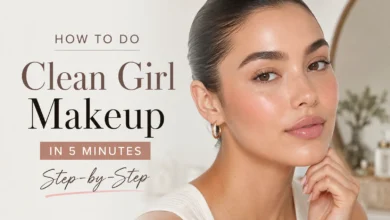
Everyday Makeup: Building a Routine That Takes Minutes, Not Hours
Makeup doesn’t need to be all-or-nothing. Most people are best served by a “everyday” routine that takes under 10 minutes and a slightly more built-up “occasion” routine they save for going out. The everyday version usually covers:
- Light coverage (concealer or tinted moisturizer, not full foundation)
- Brow definition
- Mascara
- A cream blush or lip tint that can double for both cheeks and lips
The goal of an everyday routine is to look like a well-rested version of yourself, not a different person. This is also the routine most worth investing time in learning well, since it’s the one you’ll repeat almost daily.
A simple everyday application order:
- Skincare and SPF (always applied first, and given a minute to settle)
- Light coverage — concealer where needed, blended with a damp sponge or fingers
- Brows, filled in with light, short strokes rather than one solid line
- Cream blush, applied to the apples of the cheeks and blended upward
- Mascara, applied to clean, dry lashes with a slight wiggle at the root
- Lip tint or balm as the final step
Tools worth owning: a damp makeup sponge for a natural finish, one dense blending brush for cream products, and a spoolie for brushing brows into place. You don’t need a full brush set to get a polished everyday look — three well-chosen tools outperform a fifteen-piece set most people never fully use.
Also Read: Makeup Tips for Everyday Beauty: A Beginner’s Guide to Natural, Effortless Looks
Hair Care: The Routine Most People Get Wrong
Hair care is where the most common mistakes happen — mostly from copying a routine built for a completely different hair type. A routine built for thick, coily hair (heavy oils, infrequent washing) applied to fine, straight hair will leave it looking flat and greasy within a day. The reverse is just as true.
The fundamentals that apply across nearly every hair type:
- Match your wash frequency to your scalp’s oil production, not a generic “every other day” rule
- Use conditioner focused on mid-lengths and ends, not the scalp
- Use heat protectant every time you use hot tools, no exceptions
- Trim regularly enough to stay ahead of split ends — roughly every 8–12 weeks for most people
A simple wash-day routine:
- Brush hair before washing to reduce breakage and tangling in the shower
- Shampoo the scalp, letting the lather naturally rinse through the lengths rather than piling shampoo on the ends
- Apply conditioner from mid-length to ends, leaving it on for at least 2–3 minutes
- Rinse with cooler water where possible — it helps the hair cuticle lie flatter, which means more shine
- Use a microfiber towel or cotton t-shirt instead of a regular towel to reduce frizz
- Apply any leave-in products or heat protectant while hair is still damp
Hair texture, porosity, and density all affect how well a given product works, which is why two people with the same length of hair can need completely different routines. Low-porosity hair, for example, tends to repel heavy products and does better with lighter, water-based formulas, while high-porosity hair often needs richer, oil-based products to seal in moisture.
Also Read: Hair Care Routine 101: How to Build Healthy Hair Habits for Your Hair Type
Self-Care and Natural Beauty: The Habits Behind the Habits
The fourth pillar is the one most beauty guides skip, and it’s arguably the one with the biggest visible impact over time. Sleep, hydration, diet, and stress management directly affect skin clarity, under-eye circles, hair shedding, and even how makeup sits on your face throughout the day.
This doesn’t mean overhauling your entire lifestyle. Small, sustainable habits — a consistent sleep schedule, drinking enough water, a five-minute face massage to de-puff — compound the same way skincare does.
Also Read: Natural Beauty and Self-Care Tips: Simple Habits for a Healthier Glow
A Simple Ingredient Glossary: What to Look For (and What to Avoid)
You don’t need a chemistry degree to shop smart. Knowing a handful of ingredient names — and what they actually do — is enough to read almost any product label with confidence.
| Ingredient | What It Does | Best For |
|---|---|---|
| Hyaluronic Acid | Draws moisture into the skin | Dry, dehydrated, or all skin types |
| Niacinamide | Calms redness, minimizes pores, evens tone | Oily, sensitive, or acne-prone skin |
| Retinol | Speeds cell turnover, softens fine lines | Anti-aging, texture, acne (start slow) |
| Vitamin C | Brightens, protects against environmental damage | Dullness, dark spots, morning routines |
| Ceramides | Rebuilds and protects the skin barrier | Dry, sensitive, or barrier-damaged skin |
| Salicylic Acid | Exfoliates inside pores, reduces breakouts | Oily and acne-prone skin |
| Glycolic/Lactic Acid | Exfoliates the skin’s surface, improves texture | Dullness, uneven texture, mild pigmentation |
| Sulfates (in hair care) | Strong cleansing agents that can strip natural oils | Best avoided for dry, curly, or color-treated hair |
A good rule of thumb: pick one or two active ingredients that address your actual top concern, rather than a product with ten actives stacked together. More isn’t more effective — it’s usually just more likely to irritate.
Beauty Routines by Skin Concern
Different concerns call for different priorities within the same basic framework. Here’s how the core routine shifts depending on what you’re actually trying to solve.
For acne-prone skin: Prioritize a gentle, non-stripping cleanser (harsh cleansers can trigger more oil production), a lightweight oil-free moisturizer, and a single exfoliating active like salicylic acid a few times a week — not daily. Avoid layering too many acne-fighting products at once, which is a common cause of over-drying and irritation.
For dry or dehydrated skin: Focus on barrier-repairing ingredients like ceramides and hyaluronic acid, skip harsh foaming cleansers, and consider a richer night moisturizer or a facial oil layered on top of your regular moisturizer.
For sensitive or reactive skin: Simplicity is the priority. Fragrance-free formulas, fewer active ingredients, and patch-testing every new product for 48 hours before applying it to your whole face will prevent most reactions before they start.
For dullness or uneven tone: Gentle exfoliation (chemical over physical scrubs, which can cause micro-tears), vitamin C in the morning, and consistent SPF use are the three biggest levers for brighter, more even-looking skin over time.
For visible signs of aging: Retinol remains the most researched ingredient for fine lines and texture, but it needs to be introduced slowly — starting once or twice a week and building up — alongside consistent SPF, since unprotected sun exposure undoes retinol’s benefits.
Beauty Routines Through the Seasons
Skin and hair needs shift throughout the year, and a routine that works perfectly in summer can leave skin flaky and tight by winter.
- Spring: A good time to reintroduce exfoliation after winter dryness and lighten up heavy winter moisturizers.
- Summer: Sweat, oil production, and sun exposure all increase — lighter, oil-free formulas and reapplying SPF throughout the day become more important.
- Fall: Skin often needs a gradual return to richer moisturizers as humidity drops; a good season to start a new retinol routine since sun exposure is typically lower.
- Winter: Barrier support becomes the priority — richer moisturizers, gentler cleansers, and protecting hair from static and dryness with added hydration.
Rather than switching your entire routine every season, think of it as dialing the same core routine up or down — a slightly richer moisturizer here, a lighter one there — instead of starting over.
Building a Beauty Routine on Any Budget
| Budget Tier | Skincare | Makeup | Hair Care | Monthly Estimate |
|---|---|---|---|---|
| Starter | Drugstore cleanser, moisturizer, SPF | Multi-use stick (cheek + lip), mascara, concealer | Basic sulfate-free shampoo/conditioner | Low |
| Mid-Range | Drugstore + 1–2 targeted actives (vitamin C, retinol) | Foundation, brow product, lip and cheek separately | Shampoo, conditioner, one weekly hair mask | Moderate |
| Premium | Dermatologist-recommended actives, prescription options | Full everyday + occasion kit | Salon-quality products, occasional treatments | Higher |
The biggest myth in beauty is that a bigger budget guarantees better results. Consistency with a starter-tier routine will outperform inconsistency with a premium one every time. Increase your budget only after your basic routine is solid and you’ve identified a specific gap it isn’t solving.
The Psychology of Beauty Routines: Why They’re About More Than Looks
There’s a reason a five-minute skincare routine or a “put together” makeup look can shift someone’s entire mood before they’ve left the house. Beauty routines function as a form of daily ritual — a small, controllable act of care at the start or end of the day, regardless of what else is happening.
This is worth naming because it changes how you should think about “perfecting” your routine. A routine that feels calming and makes you feel like yourself is more valuable than one that’s technically more advanced but feels like a chore. The goal isn’t to follow every step a beauty influencer recommends — it’s to build a routine that fits your actual life and makes you feel good using it.
How to Build Your Personal Beauty Routine: Step-by-Step
| Step | What to Do | Why It Matters |
|---|---|---|
| 1 | Identify your skin type and hair type | Every product recommendation depends on this |
| 2 | Start with the 3-step skincare basics (cleanser, moisturizer, SPF) | Builds the foundation before adding complexity |
| 3 | Add one everyday makeup step at a time | Prevents overwhelm and lets you judge what you actually use |
| 4 | Match your hair wash and styling routine to your hair’s actual needs | Avoids copying routines built for a different hair type |
| 5 | Layer in one active ingredient at a time (retinol, vitamin C, exfoliating acid) | Reduces irritation risk and lets you track results |
| 6 | Add self-care habits (sleep, hydration) around your routine | Multiplies the effectiveness of every other step |
| 7 | Reassess every 6–8 weeks and adjust | Skin and hair needs shift with seasons, stress, and age |
How Beauty Routines Shift With Age
The core principles in this guide don’t change with age, but priorities within them do.
In your teens and early twenties: The focus is usually prevention rather than correction — a gentle cleanser, lightweight moisturizer, and consistent SPF do more long-term good than any anti-aging product, since sun damage accumulates silently for years before it shows.
In your late twenties and thirties: This is when most people start layering in the first active ingredients — a gentle retinol, vitamin C, or exfoliating acid — to address early texture and tone changes, while keeping the same protection-first foundation.
In your forties and beyond: Skin often becomes drier and slightly thinner, so richer moisturizers, barrier-supporting ingredients like ceramides, and more targeted actives (higher-strength retinoids, peptides) tend to take priority, alongside the same non-negotiable SPF habit.
At every stage, the fundamentals from earlier in this guide — consistency, matching products to your actual skin and hair, and protecting before correcting — stay exactly the same. Only the specific products and actives shift.
Common Beauty Mistakes to Avoid
- Chasing trends over fundamentals. A trending 10-step routine won’t fix a broken foundation — cleanser, moisturizer, and SPF matter more than any viral product.
- Skipping sunscreen on cloudy days or indoors. UV exposure through windows and on overcast days still contributes to long-term skin damage.
- Introducing too many active ingredients at once. This is the single most common cause of sudden breakouts, redness, and irritation.
- Copying a routine built for a different skin or hair type. What works for a friend’s oily skin can genuinely damage dry or sensitive skin.
- Using heat tools without protectant. Even occasional heat styling without protection causes cumulative damage.
- Judging a routine too quickly. Most skincare and hair care changes take 4–8 weeks to show visible results — switching every two weeks means you never see what’s actually working.
- Treating self-care as optional. Sleep and hydration affect your results more than most people expect.
Beauty Myths vs. Facts
Beauty advice spreads fast, and not all of it holds up. A few of the most persistent myths worth retiring:
Myth: Oily skin doesn’t need moisturizer. Fact: Skipping moisturizer often makes oily skin produce more oil to compensate. A lightweight, oil-free moisturizer keeps oil production balanced instead of overcorrected.
Myth: Natural or “chemical-free” products are automatically safer. Fact: Every ingredient, natural or synthetic, is a chemical compound. What matters is whether it’s formulated well and suits your skin — not whether it’s labeled “natural.”
Myth: You need to feel a tingling or stinging sensation for a product to be working. Fact: Tingling is usually a sign of irritation, not effectiveness. A well-formulated active should work without noticeable discomfort.
Myth: Expensive products always outperform drugstore ones. Fact: As covered earlier, formulation and active ingredients matter far more than price point. Many top-rated dermatologist picks are drugstore products.
Myth: Makeup causes acne. Fact: It’s less about wearing makeup and more about which formulas you use and how consistently you remove it. Non-comedogenic formulas and proper nightly cleansing largely eliminate this risk.
Myth: Cutting hair makes it grow faster. Fact: Hair grows from the scalp, not the ends. Regular trims prevent breakage and split ends from traveling further up the hair shaft, which keeps hair looking healthier, but it has no effect on growth rate.
Frequently Asked Questions About Beauty Routines
How long does it take to see results from a new skincare routine?
Most people start noticing changes in texture and hydration within 2–4 weeks, while changes related to active ingredients like retinol or acids (fine lines, acne marks) typically take 8–12 weeks of consistent use.
Do I need a separate morning and evening skincare routine?
Yes, at minimum for sunscreen, which should only be applied in the morning. Many active ingredients like retinol are also better used at night since they can increase sun sensitivity.
What’s the minimum skincare routine that actually works?
Cleanser, moisturizer, and sunscreen, used consistently every single day, covers the large majority of long-term skin health needs for most people.
How often should I wash my hair?
This depends entirely on your scalp’s oil production and hair type — anywhere from daily to once a week can be correct. Fine, straight hair typically needs more frequent washing than thick, curly, or coily hair.
Is expensive makeup or skincare actually better than drugstore options?
Not necessarily. Many drugstore products use the same core active ingredients as premium brands. Price often reflects packaging, marketing, and brand positioning more than performance.
Can self-care habits really affect how my skin and hair look?
Yes. Sleep quality, hydration, and stress levels directly influence skin clarity, under-eye puffiness, and hair shedding, often as much as topical products do.
How do I know my skin type?
Wash your face, wait an hour without applying anything, then observe: shiny all over usually means oily, tight or flaky usually means dry, shiny only in the T-zone usually means combination, and reacting easily to products usually means sensitive.
Also Read: Weekend & Travel Outfit Ideas for Effortless Style On the Go