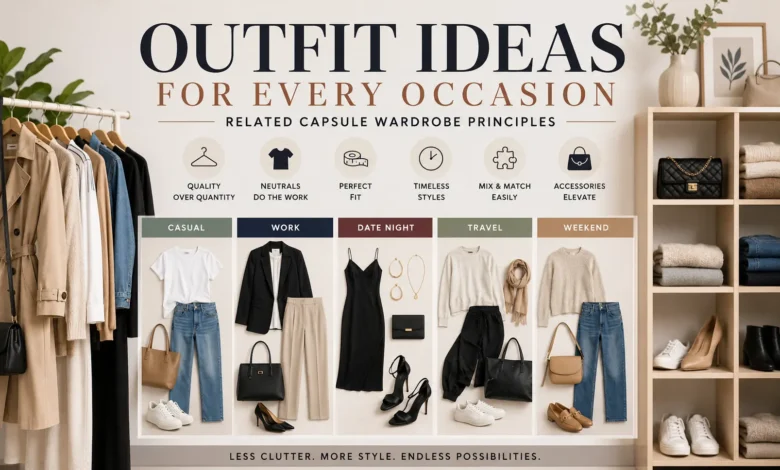
Most people don’t actually have a clothing shortage — they have a pairing shortage. A closet can hold forty items and still produce fewer usable outfits than a tightly chosen capsule of twenty, simply because a capsule is built so that nearly every piece pairs with several others. This guide breaks down the capsule wardrobe principles behind reliable, repeatable outfit ideas: how a capsule works, the rules that make one actually functional, and how to apply those rules across casual days, work, date night, and travel so getting dressed stops being a daily puzzle.
What Is a Capsule Wardrobe, Really?
A capsule wardrobe is a smaller, deliberately chosen set of clothing where most pieces are selected specifically because they pair with several other items already in the collection. It isn’t about owning as few clothes as possible — it’s about owning clothes that talk to each other. A wardrobe of 30 pieces where every top pairs with every bottom will always outperform a wardrobe of 100 pieces where half the items only work with one specific thing they were bought to match.
The idea isn’t new — stylists have used versions of it for decades — but it’s become especially relevant as a direct response to closets that grow faster than the outfits they actually produce. The goal of a capsule isn’t restriction for its own sake. It’s efficiency: fewer decisions, less clutter, and a wardrobe that reliably generates outfit ideas instead of working against you.
Why Capsule Principles Solve the “Nothing to Wear” Problem
The feeling of having nothing to wear despite a full closet is rarely about clothing volume. It’s a decision-fatigue problem. Facing too many loosely related options each morning creates choice overload, and choice overload — not lack of clothing — is usually the real reason getting dressed feels harder than it should. A smaller, well-paired capsule removes most of that overload because nearly any two items you grab will already work together. This is also why capsule wardrobes tend to reduce impulse shopping over time: once you can see clearly which combinations you’re missing, you shop for gaps instead of guessing.
The 6 Core Principles of a Working Capsule Wardrobe
These principles apply whether your capsule covers your entire wardrobe or just one occasion category, like work or travel.
1. Every Piece Earns Its Place Through Pairing, Not Novelty. Before adding anything to a capsule, ask whether it pairs with at least two or three items you already own. A beautiful piece that only works with one specific outfit is a novelty purchase, not a capsule piece.
2. Neutrals Do the Heavy Lifting. A capsule built mostly around neutral colors (black, white, navy, beige, gray) means almost every item can combine with almost every other item. Color and print are then layered in through a smaller number of accent pieces.
3. Fit Is Non-Negotiable. A capsule with ten perfectly fitted pieces will outperform a capsule with twenty pieces that fit inconsistently. Poor fit undercuts every other principle on this list, so it’s worth prioritizing tailoring over adding more items.
4. One Silhouette Story Per Capsule. Mixing too many competing silhouettes (very fitted and very oversized, for example) makes pairing harder. Choosing a general silhouette direction — tailored, relaxed, or a deliberate mix of both — keeps combinations easier to build.
5. The Three-Outfit Test. Before adding any new piece, picture three different outfits you’d build with it using items you already own. If you can’t picture three, it’s a one-outfit purchase, and one-outfit purchases are exactly what turn a capsule back into clutter.
6. Accessories Extend the Capsule Without Growing It. A structured bag, versatile jewelry, and a couple of key shoe styles can shift the same core pieces across casual, work, and evening occasions without adding a single new garment.
The rule that ties all six together: a capsule wardrobe isn’t about owning less — it’s about owning pieces that were chosen to work together in the first place.
How Many Pieces Does a Capsule Wardrobe Actually Need?
There’s no single magic number, but a useful starting range is 25-35 pieces (including outerwear and shoes) for a general everyday capsule. What matters more than the exact count is the ratio of pairings each piece supports. A well-built 30-piece capsule, where each item pairs with roughly 5-8 others, can realistically produce 50 or more distinct outfit combinations — often more outfit ideas than a much larger, less coordinated closet.
| Capsule Type | Typical Piece Count | Best For | Core Focus |
|---|---|---|---|
| Everyday Capsule | 25-35 pieces | Daily dressing across most occasions | Neutral base + a few accent pieces |
| Work Capsule | 10-15 pieces | Office and business settings | Blazers, trousers, versatile tops |
| Travel Capsule | 10-12 pieces | Trips and weekends away | Tight color palette, layering pieces |
| Seasonal Capsule | 15-20 pieces | One season at a time | Weather-appropriate layering |
| Occasion Capsule | 6-8 pieces | Date night and special events | One dress, one jacket, key accessories |
Building an Everyday Capsule: Step-by-Step
Start with a core neutral base. A few well-fitted basics in versatile colors — a white shirt, dark denim, a black blazer, a neutral knit — form the backbone that almost any other piece can pair with.
Add two to three “anchor” pieces per season. These are slightly more distinctive items — a patterned skirt, a colored coat, a textured knit — that give outfits personality without overwhelming the capsule’s coordination.
Choose accessories that cross categories. A structured bag, gold hoops, and a versatile belt can elevate a casual outfit, a work outfit, and a date-night outfit without any additional garment purchases.
Audit before you add. Before buying something new, run the three-outfit test above. If the answer is no, it’s likely to become a closet orphan rather than a capsule piece.
Rotate rather than replace. A capsule isn’t static — swap in seasonal pieces and swap out worn items, but keep the underlying principle intact: every new addition should pair with several things already there.
Applying Capsule Principles to Casual Outfit Ideas
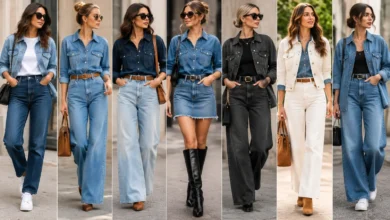
Casual outfits get the most daily use, which makes them the best place to see capsule principles in action. A fitted t-shirt, well-fitted jeans, and clean sneakers is a reliable, near-foolproof combination precisely because each piece was chosen for its pairing potential rather than as a standalone statement. From there, an oversized shirt worn over a fitted tank, a cropped knit tucked into denim, or the same jeans dressed up with loafers instead of sneakers all stretch a small number of pieces into a much larger set of outfit ideas.
Also Read: Casual Outfit Ideas for Everyday Comfort and Style
Applying Capsule Principles to Work Outfit Ideas
A functional work capsule usually includes two to three blazers in versatile colors, three to four bottoms that all pair with those blazers, five to six tops in solid colors, one or two dresses, and two to three pairs of shoes covering different formality levels. Because every piece is chosen to pair with several others, this kind of capsule can produce weeks of outfit combinations without repeating the same exact look twice — and it adapts across formal, business-casual, and smart-casual dress codes just by changing which pieces get combined.
Also Read: Office & Work Outfit Ideas That Look Sharp and Feel Professional
Applying Capsule Principles to Date Night Outfit Ideas
Even occasion dressing benefits from capsule thinking. A small rotating set — one versatile dress, well-fitted denim or trousers, one elevated top, one jacket that dresses an outfit up, and a couple of statement accessories — can generate a wide range of date-night looks without requiring a new outfit for every occasion. The key is choosing pieces you already feel confident in, then using capsule-style accessories to create the “special occasion” feeling.
Also Read: Date Night Outfit Ideas to Feel Confident and Beautiful
Applying Capsule Principles to Travel Outfit Ideas
Travel is where capsule principles matter most, because packing space is limited and coordination directly affects how much you can leave at home. Building a travel capsule around two or three coordinating colors, with layering pieces for changing temperatures and just two or three pairs of shoes, can produce a full week or more of distinct outfits from a single carry-on. Repeating individual pieces — like the same well-fitted jeans styled differently across several days — is a normal, practical extension of capsule thinking rather than something to avoid.
Also Read: Weekend & Travel Outfit Ideas for Effortless Style On the Go
Capsule Wardrobe Building on a Budget
Capsule principles work at any price point, since the focus is on pairing potential rather than spending more overall.
Prioritize fit and tailoring first. A basic hem or waist adjustment is often inexpensive and can make a lower-cost piece look considerably more polished simply because it fits properly.
Invest more in high-wear basics. Items worn weekly — well-fitted jeans, a blazer, everyday shoes — are worth a slightly higher budget allocation, since their cost per wear drops quickly with frequent use.
Save on trend-driven pieces. Items tied to a short-term trend are reasonable to buy at a lower price point, since a capsule doesn’t require every piece to be a long-term investment.
Shop your own closet before shopping stores. Try re-pairing existing pieces in combinations you haven’t tried yet — this often reveals outfit ideas you already have the pieces for, without spending anything.
Choose versatile neutrals for bigger purchases. When spending more on a single piece — a coat, a bag, a pair of boots — a versatile neutral extends its use across far more outfits than a trend color would.
Building a Capsule Color Palette That Actually Works
The single biggest factor in whether a capsule succeeds or quietly falls apart is the color palette behind it. A capsule doesn’t need to be entirely neutral, but it does need a clear, limited palette that every piece is chosen against.
Pick two to three neutrals as your base. Black, white, navy, beige, and gray are the most common choices because they combine with nearly everything, including each other.
Add one or two accent colors. A single accent color — a deep red, an olive green, a cobalt blue — gives a capsule personality without breaking its coordination. Keep accent colors to items you’re comfortable repeating, since they’ll show up in several outfits.
Test new pieces against the palette before buying. If a piece doesn’t fit within your established neutrals or accent colors, it’s more likely to become an isolated item that doesn’t pair easily with the rest of the capsule.
Let patterns pull from the same palette. A printed piece is far easier to style within a capsule when its color story matches your existing neutrals and accents, rather than introducing an entirely new color family.
This is also where seasonal capsules diverge slightly from a year-round palette — a summer capsule might lean into lighter neutrals like cream and soft blue, while a fall capsule shifts toward richer tones like chocolate brown and rust, all while keeping the same underlying pairing logic intact.
Seasonal Capsules: Rotating Without Starting Over
A seasonal capsule doesn’t mean replacing your entire wardrobe four times a year — it means rotating a smaller set of season-specific pieces in and out while keeping your core anchor pieces constant year-round.
Keep your anchors in place. Well-fitted denim, a black blazer, and simple neutral tops typically work across every season with only a layering change, so there’s no need to swap them out.
Rotate outerwear and layering pieces by season. A lightweight trench for spring, breathable linens for summer, a structured coat for fall, and a wool coat for winter are the pieces most worth dedicating seasonal capsule space to.
Store off-season pieces separately. This keeps your active capsule easier to see and choose from, rather than mixing summer sandals in with winter boots in a way that adds visual clutter without adding real options.
Reassess each season rather than accumulating. Before adding new seasonal pieces, check whether last year’s version still fits the current capsule’s palette and pairing logic — many seasonal pieces can be reused for several years if chosen with capsule principles in mind from the start.
Building a capsule around aspiration rather than actual lifestyle. A capsule full of pieces for a lifestyle you don’t currently have (frequent formal events, for example) will feel unusable day to day. Build around how you actually spend your time.
Treating “neutral” as boring rather than foundational. Neutral doesn’t mean personality-free — it means the base that lets accent pieces and accessories carry your personal style without limiting pairing options.
Skipping the three-outfit test. Adding pieces without confirming they pair with several existing items is the fastest way for a capsule to quietly turn back into an unpaired, cluttered closet.
Ignoring proportion and silhouette consistency. A capsule with too many competing silhouettes makes pairing genuinely harder, even if every individual piece is well-made.
Rebuilding from scratch every season. A capsule is meant to evolve gradually — swapping a few pieces in and out — rather than being replaced wholesale, which defeats the cost and time efficiency the approach is built around.
Also Read: How to Build a Capsule Wardrobe
Conclusion
Capsule wardrobe principles are really outfit-idea principles in disguise: choose pieces for how well they pair rather than how they look in isolation, lean on neutrals to maximize combinations, prioritize fit over volume, and always run new purchases through the three-outfit test. Applied across casual days, work, date night, and travel, these same six rules turn a smaller, more intentional wardrobe into a far more reliable source of outfit ideas than a larger, uncoordinated one ever could be. Start with your current closet, audit what already pairs well, and build outward from there — the rest of the wardrobe follows the same logic.
Frequently Asked Questions
What is the difference between a capsule wardrobe and a minimalist wardrobe?
A capsule wardrobe focuses specifically on pairing potential — every piece is chosen because it works with several others — while minimalism is a broader lifestyle approach to owning fewer possessions in general. A capsule wardrobe is often a practical tool within a minimalist approach, but the two aren’t identical.
How many outfits can a capsule wardrobe realistically create?
A well-built capsule of around 25-35 pieces, including outerwear and shoes, can typically generate 50 or more distinct outfit combinations, since each piece is deliberately chosen to pair with multiple others rather than standing alone.
Do I need a separate capsule for work and casual wear?
Not necessarily — many pieces, like a tailored blazer or well-fitted trousers, can cross between work and casual capsules. A single well-planned wardrobe with a few occasion-specific additions is often more efficient than building entirely separate capsules.
How do I start building a capsule wardrobe from an existing closet?
Begin by auditing what you already own, identifying which pieces already pair with several others, and applying the three-outfit test to anything you’re unsure about keeping or adding. Building a capsule is usually more about reorganizing and selectively editing than starting over.
Is a capsule wardrobe more expensive than a regular wardrobe?
Not inherently — capsule principles work at any budget, since the focus is on pairing potential rather than higher spending. Prioritizing fit and versatile neutrals over larger quantities of trend pieces can actually reduce overall spending over time.
How often should I update a capsule wardrobe?
Rather than rebuilding on a fixed schedule, update gradually — swap in a few seasonal pieces, replace items as they wear out, and periodically re-run the three-outfit test on things you’re not wearing much, rather than replacing the whole collection at once.
For the broader framework these principles come from, see our complete guide: [Outfit Ideas for Every Occasion: The Complete Guide to Building Looks You’ll Actually Wear].