Dressing for work sits in a unique category: the outfit needs to feel professional, hold up through a full day of meetings and movement, and still reflect your personal style. Unlike casual dressing, where the stakes of an “off” outfit are low, work outfits carry a bit more pressure — and the right approach depends heavily on your workplace culture, from formal corporate offices to relaxed creative studios. This guide breaks down outfit formulas by dress code, a capsule you can build once and rewear for months, and the small mistakes that quietly undercut an otherwise professional look.
Understanding Your Office Dress Code First
Before building a work capsule, it helps to identify which category your workplace falls into, since the right outfit ideas differ significantly across them.
Formal corporate: Structured suiting, tailored trousers, blazers, and closed-toe shoes are typically expected. Color palettes tend to stay neutral, with personal style expressed through cut and accessories rather than bold color or pattern.
Business casual: This is the broadest category — tailored trousers or skirts paired with blouses or knitwear, blazers optional but useful, and a wider range of acceptable shoe styles including loafers and low heels.
Smart casual / creative office: More relaxed dress codes still benefit from a “one polished element” rule — pairing a casual piece, like well-fitted jeans, with a more structured item, like a blazer or tailored top, keeps the outfit from reading as too casual for a work setting.
The 6 Core Principles of Professional Outfit Building
These apply across nearly every office dress code, from formal to smart casual.
1. The Blazer Is Your Most Versatile Tool. A tailored blazer worn over almost anything — a simple tee, a blouse, even a casual dress — instantly reads as “put together” across formal, business-casual, and smart-casual settings alike.
2. Fit Signals Professionalism Faster Than Price. A well-fitted, affordable blazer will read as more polished than an expensive one that doesn’t sit right on your shoulders. Prioritize fit and tailoring over brand or cost when building a work capsule.
3. Comfort Determines Whether You’ll Actually Rewear a Piece. Office days are long. A gorgeous but restrictive outfit gets worn once; a comfortable, well-fitted one gets worn weekly. Choose fabrics with a little stretch and silhouettes you can sit in for eight hours.
4. Rotate Accessories and Outerwear, Not Core Pieces. A small work capsule can feel much larger than it is simply by changing the blazer, bag, or shoes paired with the same base outfit each day.
5. Match Formality to Shoe Choice. Shoes are one of the fastest ways to shift an outfit’s formality level — the same trouser-and-top combination can read as formal with heels, business-casual with loafers, or smart-casual with clean flats.
6. Keep a Consistent Color Palette. A work capsule built around two or three neutrals, plus one or two accent colors, means almost every top pairs with almost every bottom — which is what actually makes a smaller capsule feel effortless to dress from each morning.
The rule that ties all six together: professional dressing is less about formality for its own sake and more about looking consistently put-together with the least possible daily effort.
Work Outfit Formulas by Dress Code
| Formula | Core Pieces | Best For | Formality Level |
|---|---|---|---|
| Classic Blazer Combo | Blazer, blouse or tee, trousers | Nearly every office type | Adjustable |
| Skirt-and-Knit Pairing | Knee-length skirt, knit top, blazer/cardigan | Formal to business-casual | Medium–High |
| Wide-Leg Trouser Set | Wide-leg trousers, tucked blouse, belt | Business-casual desk days | Medium |
| Smart-Casual Denim Look | Dark denim, blazer, simple top | Relaxed and creative offices | Medium–Low |
| Shirt Dress | Belted shirt dress, heels or flats | Busy mornings, quick dressing | Adjustable |
The Classic Blazer Combo
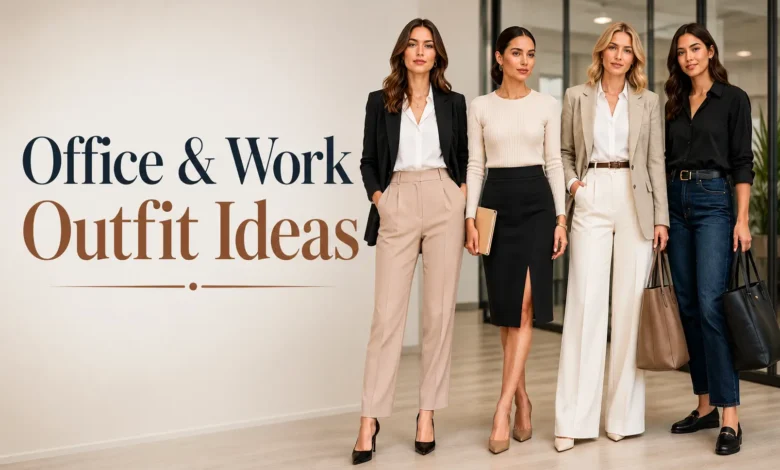
A tailored blazer over a simple blouse or fitted tee, paired with straight-leg or wide-leg trousers, works across almost every office dress code. Swapping the blazer’s color or the shoe style — loafers versus heels versus flats — shifts the formality level without needing an entirely new outfit each time.
The Skirt-and-Knit Pairing
A knee-length pencil or A-line skirt with a fitted knit top and a blazer or cardigan layered over it is a reliable formal-to-business-casual formula. Adding tights in cooler months keeps it seasonally practical.
The Wide-Leg Trouser Set
Wide-leg trousers paired with a tucked-in blouse and a slim belt create a polished silhouette that also happens to be one of the most comfortable options for long days at a desk.
The Smart-Casual Denim Look
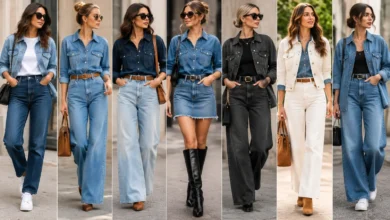
For more relaxed offices, well-fitted dark-wash jeans, with no distressing, paired with a tailored blazer and a simple top strike the right balance between comfortable and professional. Loafers finish the look better than sneakers in most business-casual settings.
The Shirt Dress
A structured shirt dress, belted at the waist, works as a one-piece outfit solution for busy mornings and can be dressed up with heels or down with flats depending on the day’s meetings.
Also Read: Casual Outfit Ideas for Everyday Comfort and Style
Building a Capsule Work Wardrobe
A functional work capsule typically includes:
- Two to three blazers in versatile colors, such as black, navy, or a neutral tweed
- Three to four pairs of trousers or skirts that all pair with the blazers above
- Five to six tops or blouses in solid colors that mix across the bottoms
- One or two dresses that can be dressed up or down with layering
- Two to three pairs of shoes covering different formality levels, such as heels, loafers, and flats
Because every piece is chosen to pair with several others, this kind of capsule can produce weeks of outfit combinations without repeating the exact same look twice. The goal isn’t to own more work clothes — it’s to own work clothes that were selected specifically because they pair with each other.
Work Outfit Ideas by Season
Warmer months: Lightweight blazers in linen or cotton blends, breathable trousers, and short-sleeve blouses keep you comfortable in the office without sacrificing polish. Open-toe block heels are often acceptable in business-casual settings during summer.
Cooler months: Layer a lightweight knit under your blazer, and swap open shoes for closed-toe flats, loafers, or boots. A structured coat over your usual work outfit keeps the commute comfortable without needing a separate “outdoor” look.
Transitional weather: A single lightweight layer — a cardigan or a light blazer — added or removed as needed lets one base outfit adapt to a wider temperature range across the workday.
Comfortable Shoes That Still Look Professional
Long workdays call for shoes that balance polish and comfort. Block-heeled loafers, pointed-toe flats with cushioned insoles, and low kitten heels all read as professional while being significantly more wearable across a full day than very high heels. Rotating between two or three pairs also extends the life of each pair and gives outfits subtle variety without any new purchases.
Transitioning Work Outfits From Desk to After-Work Plans
A simple swap-based approach makes it easy to take a work outfit into after-work plans without a full outfit change:
- Swap flats or loafers for heels or ankle boots
- Remove the blazer and add a statement necklace or earrings
- Swap a structured work tote for a smaller crossbody or clutch
- Add a lip color or accessory that shifts the mood from office to evening
Building a Work Capsule on a Budget
Prioritize the blazer first. A well-fitted blazer is the single highest cost-per-wear investment in a work wardrobe, since it works across nearly every formula on this list.
Buy trousers before buying more tops. A well-fitted pair of trousers pairs with more tops than a single trendy top pairs with bottoms, making trousers a more efficient early purchase.
Save on trend-driven blouses or accessories. Items tied to a shorter style moment are reasonable to buy at a lower price point, since a work capsule doesn’t require every piece to be a long-term investment.
Use tailoring strategically. A basic hem or waist adjustment on an affordable piece often produces a more polished result than buying a pricier piece that doesn’t quite fit.
Rotate rather than expand. Before adding a new piece, apply the three-outfit test: picture three outfits you’d build with it using clothes you already own. If you can’t picture three, it’s more likely to sit unworn.
Also Read: Outfit Ideas for Every Occasion — Related Capsule Wardrobe Principles
Work Outfit Ideas for Specific Scenarios
Job Interviews
Lean slightly more formal than your target role’s everyday dress code, since interviews are one setting where being slightly overdressed reads better than underdressed. A well-fitted blazer, tailored trousers, and minimal accessories keep the focus on the conversation rather than the outfit.
Client Meetings or Presentations
Choose your most polished, well-fitted formula — typically the classic blazer combo — and keep colors on the neutral side so the outfit doesn’t compete for attention during a presentation. A single confidence-boosting accessory, like a structured watch or simple jewelry, is enough.
Long Commute Days
Prioritize wrinkle-resistant fabrics and comfortable shoes for the commute itself, keeping a smaller pair of heels or dressier flats at your desk to change into if needed. This avoids arriving at the office already looking rumpled from transit.
Hybrid or Work-From-Home Video Calls
Since only the top half is usually visible, invest slightly more effort into a polished top or blazer while keeping the bottom half comfortable — a practical way to look professional on camera without sacrificing all-day comfort.
Accessorizing Office Outfits
Accessories do a lot of work in office dressing, since dress codes often limit how much personality can come through the clothing itself. A structured tote or laptop bag in a neutral color pairs with nearly every work outfit and reads as more professional than a casual crossbody. Simple, not-too-large jewelry — stud earrings, a thin necklace, a classic watch — adds polish without risking a distraction in meetings. A silk scarf, worn as a neck accessory or tied to a bag handle, is a low-cost way to introduce color or pattern into an otherwise neutral capsule. And a well-chosen belt can define the waist on looser blouses or dresses, adding shape without needing a different silhouette altogether.
Work Outfit Ideas by Body Type
The same proportion-balance principle that applies to any outfit works especially well in office dressing, where silhouettes tend to be more structured. A fuller hip or thigh area often looks balanced with a more structured shoulder — a blazer or statement sleeve — paired with straight-leg or wide-leg trousers rather than very fitted styles. A fuller midsection can look comfortable in wrap-style blouses or dresses that create definition at the waist without feeling restrictive through a full workday. Petite frames often benefit from higher-rise trousers and blazers tailored to hit at the natural waist, which helps avoid a shorter, boxier silhouette. Taller frames have more flexibility with longer blazers and wide-leg trousers, since there’s more length to balance the proportions. As always, these are flexible starting points — comfort through a full workday is usually the better guide than any general body-type rule.
Also Read: Date Night Outfit Ideas to Feel Confident and Beautiful
Common Work Outfit Mistakes to Avoid
Wearing overly casual fabrics in formal settings. A piece in heavy cotton jersey can undercut an otherwise professional silhouette, even if the cut is right.
Ignoring proportion when layering. A blazer sized only to your body, rather than to fit comfortably over a bulkier knit underneath, can create a boxy silhouette — sizing the blazer to fit over the layer solves this.
Overlooking wrinkle-prone fabrics. For a long commute or a busy workday, look for wrinkle-resistant blends when buying core pieces, since visible creasing undercuts a polished look faster than almost anything else.
Repeating the exact same combination. Rotating pieces, rather than defaulting to one single outfit, makes a small capsule feel considerably larger than it actually is.
Choosing formality over comfort. An outfit that looks sharp but is uncomfortable to sit in for eight hours tends to get worn once and then avoided — comfort and professionalism aren’t opposites when the fit and fabric are right.
Frequently Asked Questions
What is a versatile work outfit that works for both formal and business-casual offices?
A tailored blazer, straight-leg trousers, and a simple blouse is versatile enough to read as formal in a corporate setting or business-casual in a more relaxed office, with the shoe choice — heels versus loafers — helping adjust the formality level.
How many outfits do I actually need for a work wardrobe?
A well-planned capsule of 10-15 mix-and-match pieces, including blazers, trousers, tops, and shoes, can typically generate two to three weeks’ worth of distinct outfits without repeating the same exact combination.
What shoes are both professional and comfortable for a full workday?
Block-heeled loafers, cushioned pointed-toe flats, and low kitten heels are commonly recommended because they maintain a professional look while being more comfortable than very high heels for extended wear.
Can jeans be worn as part of a professional work outfit?
In business-casual or smart-casual offices, well-fitted dark denim without distressing can work as part of a professional outfit when paired with a tailored blazer and structured top, though formal corporate settings typically still expect trousers or skirts.
How do I make my work outfits feel less repetitive without buying a lot of new clothes?
Rotate accessories, outerwear, and shoes rather than the core pieces themselves, and experiment with different combinations of the same capsule items — a small wardrobe built for versatility can produce far more outfit ideas than it initially appears to hold.
What’s the single best investment piece for a work wardrobe?
A well-fitted, versatile blazer is usually the highest cost-per-wear investment, since it works across nearly every work outfit formula and can shift an outfit’s formality level up or down depending on what it’s paired with.
How do I transition a work outfit into after-work plans without changing completely?
Swap flats for heels, remove the blazer and add a statement accessory, and switch to a smaller bag. These small changes shift the mood of an outfit from professional to evening-appropriate without a full wardrobe change.
How do I dress professionally for a job interview without buying a whole new outfit?
Lean slightly more formal than the role’s everyday dress code using pieces you already own — a well-fitted blazer, tailored trousers, and minimal accessories usually cover most interview settings without needing new purchases.
What fabrics hold up best for a full workday and long commute?
Wrinkle-resistant blends, structured cottons, and ponte knits tend to hold their shape better than very soft jersey or pure linen, making them more practical for long office days and daily commuting.
Conclusion
Professional dressing doesn’t require a closet full of separate “work clothes” — it requires a handful of versatile pieces chosen specifically because they pair with each other, built around a blazer-first approach and a consistent, simple color palette. Whether your office calls for formal suiting or smart-casual denim, the same core principles apply: prioritize fit and comfort, rotate accessories rather than core pieces, and let shoes do the heavy lifting when you need to shift formality. Start with one blazer and one pair of well-fitted trousers, and build the rest of your work capsule outward from there.
For the broader framework behind these formulas, see our complete guide: Outfit Ideas for Every Occasion: The Complete Guide to Building Looks You’ll Actually Wear.